PVC Mixer Machine: Why Is Mixing Important Before Extrusion?
29 September, 2026
A conical twin screw extruder normally uses two intermeshing screws whose diameters decrease from the feeding end toward the discharge end. In many PVC processing applications, the screws rotate in opposite directions to convey, compress, plasticize and meter the material into an extrusion die. The exact processing behavior depends on the screw geometry, material formulation, feeding system, temperature profile and downstream die.
The EANS conical twin screw extruder is engineered to meet these evolving manufacturing demands. Its precision-designed conical screw geometry creates a balanced extrusion process by optimizing material intake, compression, mixing, plasticization, and pressure build-up within a single system. This enables stable processing across a wide range of formulations while maintaining consistent melt quality and continuous production.
Whether processing PVC compounds, PE-based formulations, WPC composites, or other customized material systems, the EANS conical twin screw extruder provides the flexibility required for modern industrial extrusion.
In this article, we’ll explore the working principle, multi-material processing capabilities, and key industrial applications that make the EANS conical twin screw extruder a versatile solution for today’s extrusion manufacturers.
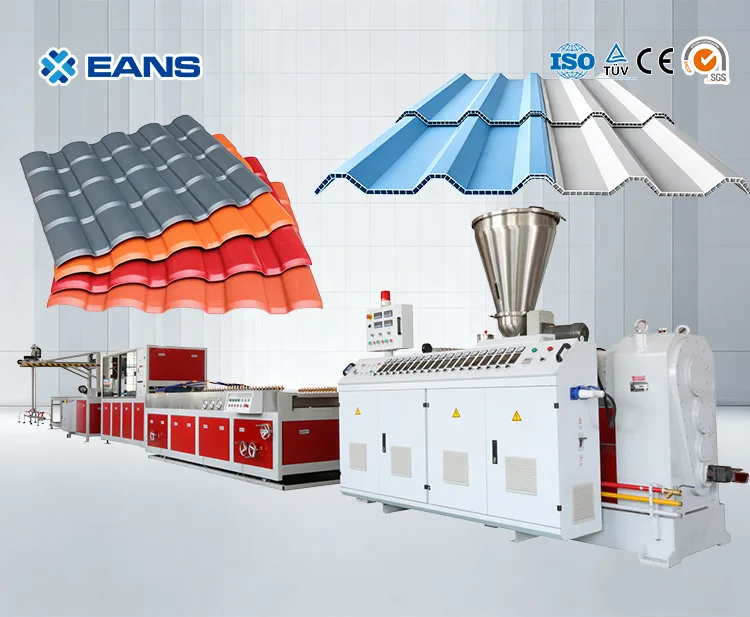
A Conical Twin Screw Extruder is a high-efficiency plastic processing machine designed for continuous mixing and extrusion. Its core structure consists of two intermeshing screws arranged in a conical configuration, with the screw diameter gradually decreasing from the feeding end to the discharge end. As the screws rotate inside the heated barrel, they provide controlled conveying, compression, mixing, plasticization, and homogenization of the material.
This distinctive conical geometry allows the machine to generate controlled shear, efficient pressure build-up, and uniform melt quality, making it suitable for processing materials with different viscosity, filler content, and thermal characteristics.

This distinctive conical geometry stands in clear contrast to the parallel twin screw extruder, where the screw diameter remains essentially constant along the processing length. It is not a matter of appearance, but a purpose-engineered configuration designed around the physical changes that PVC dry blends undergo during extrusion. The progressive change in screw diameter influences material conveying, compression, shear, plasticization, and pressure build-up, making the conical configuration particularly well suited to rigid PVC processing.
The differences between conical and parallel twin screw extruders can have a direct impact on material preparation, thermal control, mechanical load, maintenance requirements, and overall production efficiency. The following comparison highlights these differences from a practical manufacturing and purchasing perspective.
| Feature | Conical Twin Screw Extruder | Parallel Twin Screw |
| Material Input | Direct processing of powder blends; suitable for highly filled formulations | Often used with pelletized or pre-compounded materials, depending on the formulation |
| Thermal Control | Controlled shear and relatively gentle material processing | Higher shear and longer processing paths can increase thermal load in certain applications |
| Thrust Bearing Capacity | Large bearing arrangement with strong axial load capacity | Bearing space is more constrained by the parallel screw configuration |
| L/D Ratio & Energy | Typically shorter L/D, with efficient conveying and plasticization | Typically longer L/D, providing a longer processing path |
The conical twin screw extruder transforms dry powder or compound formulations into a stable, homogeneous melt through three coordinated processing zones. Rather than relying on abrupt compression or excessive shear, the conical screw geometry gradually changes the available volume along the barrel, allowing material to move through feeding, compression, melting, and pressure build-up in a controlled sequence.
This progressive material transition is one of the key reasons why conical twin screw extruders are widely used for PVC dry blends, highly filled compounds, WPC composites, and other formulations that require stable plasticization and consistent melt quality.

The process begins at the large end of the conical screws, where the screw diameter is at its maximum. This creates a larger free volume between the two intermeshing screws, allowing loose powder materials to enter the extrusion system efficiently.
Unlike compact screw entrances that can restrict material flow, the enlarged feeding section provides strong intake capacity and promotes continuous material transfer from the hopper into the screw channels. This is particularly beneficial for PVC dry blends containing stabilizers, lubricants, fillers, and other additives, as these formulations typically have lower bulk density and weaker flowability than pelletized materials.
By improving material intake at the very beginning of the process, the feeding zone helps maintain stable throughput, consistent feeding, and uninterrupted extrusion performance.
Key advantages:
• Large free volume improves powder intake.
• Stable material feeding supports continuous production.
• Better handling of low-flowability dry blend formulations.
As the material moves forward, the screw diameter gradually decreases while the screw channel volume becomes progressively smaller. Instead of compressing the material suddenly, the conical geometry applies continuous and progressive compression, creating a controlled transition from loose powder to a fully plasticized melt.
During this stage, external barrel heating works together with mechanical shear generated by screw rotation to soften, compact, and melt the material. The gradual reduction in channel volume allows resin, fillers, stabilizers, and lubricants to become uniformly distributed throughout the melt.
For heat-sensitive formulations such as PVC, maintaining controlled shear is especially important. Rather than concentrating excessive friction in a small area, the conical screw design distributes mechanical energy more evenly, helping reduce localized overheating while improving melt homogenization.
Key advantages:
Progressive compression promotes uniform plasticization.
Controlled shear helps reduce localized thermal stress.
Improved melt homogenization supports consistent product quality.

At the small end of the screws, the available space becomes significantly smaller, allowing the extrusion system to build the head pressure required to push the molten material smoothly through the die.
A distinctive advantage of this zone is that, although pressure continues to increase, the smaller screw diameter also reduces the circumferential or linear speed at the screw tip. This means the material can maintain strong pressure before entering the die while experiencing relatively lower shear than earlier processing stages.
The combination of high head pressure and controlled final-stage shear helps preserve melt stability as the material enters complex dies used for pipes, profiles, sheets, wall panels, and other extrusion products.
Key advantages:
High head pressure supports stable die filling.
Lower linear screw speed helps minimize unnecessary final-stage shear.
Consistent melt delivery improves dimensional stability and surface quality.
Rather than relying on a single compression stage, the EANS Conical Twin Screw Extruder manages material flow through a carefully balanced sequence of high-capacity feeding, progressive compression, and high-pressure discharge. This coordinated process enables efficient handling of materials with different viscosity, filler content, and thermal characteristics, making the machine suitable for both standard polymer formulations and demanding industrial extrusion applications.
The value of a Conical Twin Screw Extruder is not limited to its ability to melt and homogenize materials. For industrial production, the more important consideration is how the machine handles demanding formulations, maintains mechanical stability, adapts to different product requirements, and operates efficiently over long production cycles.
Many extrusion materials are not supplied as free-flowing pellets. They may contain mineral fillers, wood fibers, recycled content, stabilizers, lubricants, or other additives that change bulk density and flow behavior.
A conical twin screw extruder is well suited to these formulations because its screw and barrel system is designed to handle material directly from the feeding stage while progressively developing the required melt state. This makes it particularly useful for production systems based on dry blends, filled compounds, and composite formulations.
Direct processing can also eliminate an additional pelletizing step when the formulation and product requirements allow it, reducing material handling, intermediate processing, and associated energy consumption.
Industrial extrusion rarely involves a single fixed formulation throughout the lifetime of a production line. Manufacturers may need to adjust filler levels, recycled content, additives, or polymer grades according to product specifications and raw material availability.
The conical twin screw platform provides a relatively broad processing window when the screw design, temperature profile, and drive system are correctly matched to the formulation. This makes the equipment suitable for manufacturers who require greater flexibility than a machine optimized for one narrow material condition.
The important factor is not simply whether a material can be extruded, but whether the extrusion system can maintain stable production when formulation conditions change.

Filler loading can substantially change the rheology of a polymer compound. Increasing the proportion of calcium carbonate, mineral powder, wood fiber, or recycled material generally increases the mechanical and processing demands placed on the extrusion system.
For this reason, high-filler extrusion requires more than sufficient motor power. The screw configuration, gearbox capacity, bearing arrangement, barrel design, and material residence conditions must work together as a complete mechanical system.
A properly engineered conical twin screw extruder can therefore provide a robust platform for filled and composite formulations while maintaining the mechanical strength required for continuous production.
Extrusion is a continuous process, so equipment reliability is closely related to its ability to withstand sustained torque, axial thrust, pressure, and thermal cycling.
The conical twin screw configuration provides a practical mechanical arrangement in which the larger rear section offers greater space for the drive and thrust-bearing system. This is particularly relevant when processing formulations that generate high resistance during conveying and pressure development.
A properly sized gearbox and thrust-bearing assembly helps maintain screw alignment and mechanical stability, reducing the risk of premature wear under demanding operating conditions.
The extruder itself is only one part of an industrial extrusion system. Its performance depends on how the feeding, drive, heating, die, calibration, cooling, haul-off, and cutting systems are matched to the final product.
This is especially important when one extrusion platform is used for different products. Changes in product dimensions can require corresponding adjustments to screw configuration, die design, output range, and downstream equipment.
Therefore, selecting a conical twin screw extruder should be based on the complete production requirement rather than the extruder model alone.
For many industrial applications, equipment selection is ultimately a balance between output, formulation requirements, energy consumption, mechanical durability, and investment cost.
A conical twin screw extruder can offer a compact processing system with strong material-handling capability, making it a practical choice where direct powder processing, filled formulations, and continuous production are important considerations.
The appropriate configuration still depends on the material formulation, product dimensions, required output, and operating conditions. There is no universal screw configuration for every application.
At EANS machine, the conical twin screw extruder is configured as part of a complete extrusion system rather than treated as an isolated machine. Screw geometry, drive capacity, gearbox, motor, control system, die, and downstream equipment are selected according to the material and product requirements.
EANS uses Jiangyin gearboxes, Siemens motors, and ABB inverters in selected extrusion configurations to provide reliable torque transmission, stable motor operation, and precise speed control.
The final configuration is determined by the formulation, product specification, required output, and production conditions, allowing the extrusion system to be engineered around the actual manufacturing process.
As a “workhorse” in the global manufacturing of plastic building materials and infrastructure products, the Conical Twin Screw Extruder is mainly used in the following four high-value application areas:
plastic pipe production line is widely used to produce PVC-U electrical conduits for power wiring, agricultural irrigation pipes, as well as heavy-duty large-diameter pipes for urban drainage and sewage systems. The conical extruder can provide high-speed, continuous output while ensuring uniform pipe wall thickness and meeting the required pressure resistance standards.
Plastic profile extrusion line is mainly used for high-end PVC window and door profiles, WPC profiles, PVC profiles, etc. These profiles have very high requirements for surface finish, dimensional tolerances, and impact resistance. The stable die pressure provided by the conical twin screw extruder enables the PVC melt to fill the cavities of complex profile dies, helping achieve accurate dimensions and consistent profile quality.
WPC decking flooring machine is widely used to produce environmentally friendly WPC decking, outdoor wall panels, and other wood-plastic composite products that are popular in international markets. These products typically contain up to 50%–70% wood flour or plant fibers. Such high-viscosity and highly abrasive formulations place demanding requirements on the extrusion system, which can be effectively handled by the high torque and strong mixing performance of a conical twin screw extruder.
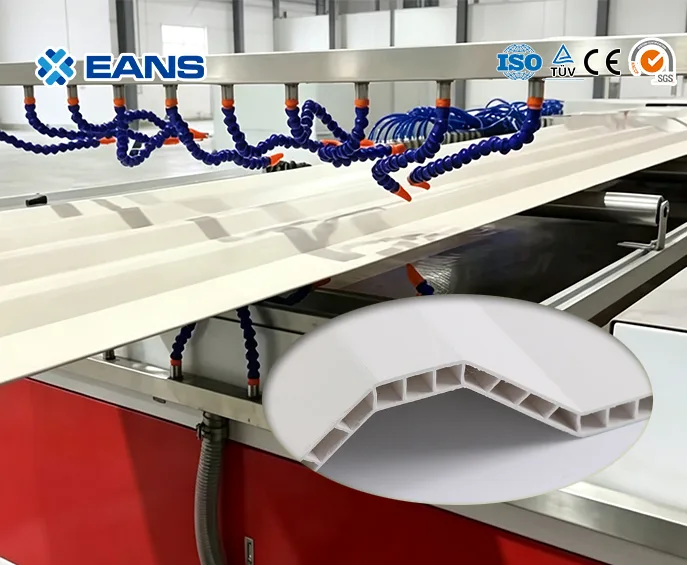
Plastic sheet extrusion line is widely used to produce wide PVC foam boards, PVC sheets, WPC foam boards for applications ranging from construction templates and advertising boards to high-end furniture and cabinet panels. The conical twin screw extruder ensures uniform dispersion of the blowing agent throughout the melt and helps control the microcellular structure, enabling the production of lightweight, high-strength boards with a hard surface.
From PVC pipes and profiles to composite boards and plastic sheets, the applications of conical twin screw extruders extend across a wide range of plastic building materials and composite products. Although the final products and material formulations may differ significantly, they all require an extrusion system that can be properly matched to the material characteristics, product specifications, and production requirements.
For manufacturers, choosing a conical twin screw extruder is therefore not simply a matter of selecting a machine model. Screw configuration, torque capacity, drive system, die design, and downstream equipment all need to work together to achieve stable and efficient production.

With extensive experience in plastic extrusion equipment, EANS Machinery provides conical twin screw extrusion solutions configured around specific materials, product dimensions, and output requirements. From screw and drive configuration to complete production line integration, the equipment can be adapted to different extrusion applications.
If you are planning a new extrusion project or looking to optimize an existing production line, contact the EANS team for a customized screw configuration or the latest equipment quotation based on your requirements.