PVC Mixer Machine: Why Is Mixing Important Before Extrusion?
29 September, 2026
For factory owners, production managers, and investors evaluating plastic extrusion equipment, understanding how a PVC foam board extrusion line actually works is essential to making a confident purchasing decision.
Unlike simple plastic panel extrusion, the PVC foam board extrusion line integrates multiple specialized sub-systems that must work in perfect synchronization. Each component — from the extruder to the cutter machine — plays a specific role in transforming PVC powder materials into a finished foam board with consistent density, smooth surface, and precise dimensions.
In this technical guide, we break down every major component of a PVC foam board extrusion line, explaining its function, working principle, and why design choices matter for production performance.

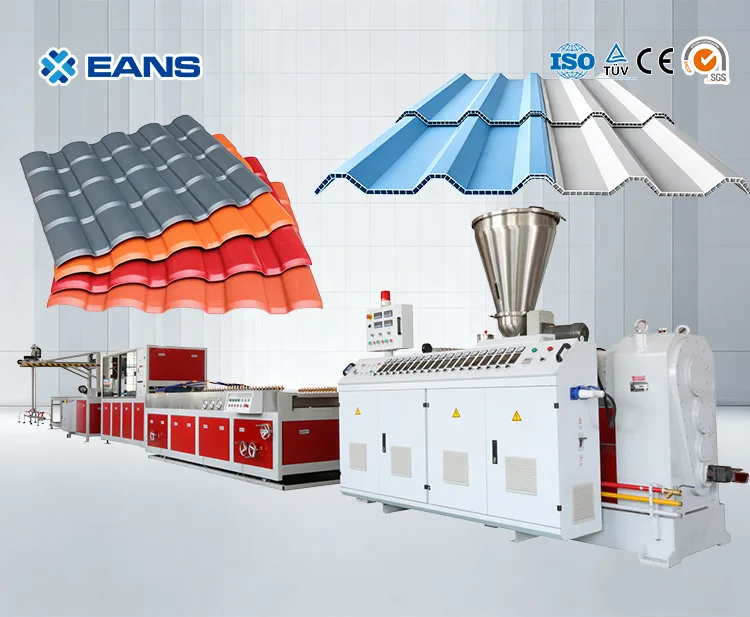
A complete PVC foam board extrusion line consists of the following interconnected systems, arranged in sequence:
Raw Material → Mixing System → Screw Loader → Conical Twin-Screw Extruder → Extrusion T-Die → Hydraulic Calibration Table → Cooling Bucket → Rubber Roller Haul-off Unit → Servo Cutting System → Stacking → Finished Foam Board
Supporting systems: circulating cooling water(cold water is crucial for the forming of sheet metal and the smoothness of its surface.), compressed air.
Each system must be properly sized and configured to match the production capacity of the others. A bottleneck anywhere in the line reduces overall efficiency.
The extruder is the most critical component of the entire PVC foam board extrusion line. It performs three essential functions: conveying, melting, and metering the material.
| Criterion | Conical Twin-Screw | Parallel Twin-Screw | Single-Screw |
|---|---|---|---|
| PVC Processing | Excellent | Good | Poor |
| Vacuum Degassing | Yes | Yes | No |
| Foaming Control | Precise | Good | Difficult |
| Power Efficiency | High | Medium | Medium |
| Material Residence Time | Short, uniform | Medium | Long |
For PVC foam board extrusion, the conical twin-screw design is the clear industry standard. Here’s why:
The twin screws in a foam board extruder are specially engineered with:
Material: Nitrided steel (38CrMoAlA) with nitriding treatment for surface hardness of HV900+ Screw diameter range: Typically 80/156 mm to 92/188 mm (conical, small end/large end)
The extruder barrel is divided into multiple heating/cooling zones:
| Zone | Function | Typical Set Point |
|---|---|---|
| Zone 1 (Feed) | Pre-heating, material conveying | 165-175°C |
| Zone 2 (Compression) | Plastication, initial melting | 175-185°C |
| Zone 3 (Metering) | Complete melting, homogenization | 180-190°C |
| Zone 4 (Adapter) | Temperature adjustment | 175-185°C |
Cooling method: Air cooling or oil cooling, depending on machine configuration Temperature accuracy: ±1°C (controlled by PID + PLC)
Modern PVC foam board extrusion lines are controlled by a Programmable Logic Controller (PLC) with Human-Machine Interface (HMI) .
| Feature | Function |
|---|---|
| Temperature control | PID auto-tuning for all heating zones |
| Speed control | Synchronized extruder, calibration, traction, cutter |
| Pressure monitoring | Die pressure, hydraulic system pressure |
| Alarm system | Temperature deviation, motor overload, low vacuum |
| Data logging | Production parameters, batch records |
| Remote access | Optional Wi-Fi/4G module for remote monitoring |
Eans Machinery uses Siemens PLC controls paired with ABB variable frequency drives and Siemens electrical components — recognized globally for reliability and ease of maintenance.
The touchscreen interface displays:
| Component | Specification | Benefit |
|---|---|---|
| Main Motor | Siemens | Reliability, energy efficiency |
| Inverter | ABB | Precise control of feeding and extrusion speed |
| Gearbox | Hardened gear, forced lubrication | Long service life, quiet operation |
One of the most important features of a twin-screw extruder for foam board production is its vacuum degassing capability.
How it works:
Without proper vacuum degassing, foam boards will develop internal voids, blisters on the surface, and inconsistent density. This is one of the most common quality issues in poorly designed extrusion lines.
The T-die is where the molten, foamable PVC is shaped into a flat sheet before entering the calibration section.
The most critical requirement for a foam board T-die is balanced flow — the melt must reach every point across the die width simultaneously and at equal pressure.
| Feature | Specification | Why It Matters |
|---|---|---|
| Material | P20 mold steel (hardened) | Wear resistance for long-term production |
| Cavity finish | Mirror-polished + chrome-plated | Smooth melt flow prevents sticking |
| Die lip adjustment | Precision bolts every 50- 100 mm | Fine-tuning of the thickness profile |
| Heating | Multi-zone cartridge heaters | ±1°C temperature uniformity |
| Manifold design | Coat-hanger type or fishtail type | Even melt distribution |
The die lip opening is adjustable, typically from 5 mm to 30 mm, allowing the same line to produce different foam board thicknesses. A flex-lip design with manual or automatic adjustment bolts enables fine-tuning of the thickness profile across the board width.
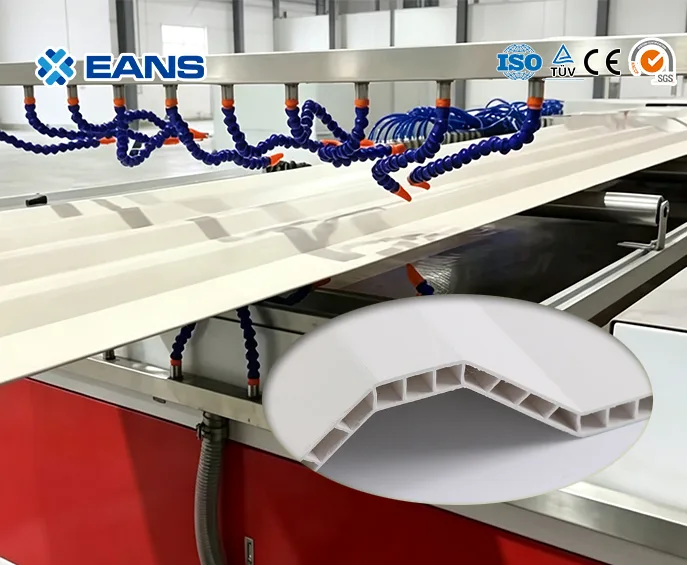
The calibration table is where the extruded melt is formed into its final shape and dimensions. This is arguably the most specialized component of a PVC foam board extrusion line.
In the Celuka (crust foam) process:
Eans Machinery uses hydraulic calibration tables — a significant advantage over electric systems:
| Aspect | Hydraulic System | Electric System |
|---|---|---|
| Pressure mechanism | Oil cylinder, continuous pressure | Lead screw/servo motor |
| Pressure stability | Constant, self-adjusting | Can fluctuate with load |
| Thick board quality | Superior flatness | Risk of uneven pressure |
| Thickness change | One-button adjustment, ~15 min | Manual adjustment, 1-3 hours |
| Maintenance | Low, sealed hydraulic system | More mechanical wear points |
The calibration table typically houses four sets of calibration molds that progressively size the board:
The molds are made from wear-resistant alloy steel with water channels for precise temperature control.
After the calibration table, the foam board enters the cooling section — typically 10M cooling bucket with:
The haul-off unit pulls the continuously extruded board through the calibration and cooling sections.
| Feature | Gear Drive | Chain Drive |
|---|---|---|
| Transmission stability | Excellent, no slip | Can stretch over time |
| Speed precision | ±0.1% | ±0.5% |
| Maintenance frequency | Low | Higher |
| Noise level | Low | Moderate |
Eans Machinery uses gear-driven traction units with 8 pairs of rubber-coated rollers for maximum grip without marking the board surface.
The traction speed must be precisely synchronized with the extruder output:
The PLC system automatically maintains this synchronization, with manual override for fine-tuning.
The cutting station performs two critical operations:
The servo-driven traveling saw:
Dual-blade trimming system:
An integrated dust collection system:
Energy efficiency is a key consideration for any factory investing in a PVC foam board extrusion line.
| Component | % of Total Power | Notes |
|---|---|---|
| Extruder motor | 55-65% | Main power consumer |
| Heating zones | 15-20% | Highest at startup |
| Calibration/cooling | 8-12% | Pumps, chillers |
| Traction/cutting | 3-5% | Servo motors |
| Auxiliary systems | 5-8% | Vacuum, compressed air |
Eans Machinery‘s PVC foam board extrusion line incorporates several energy-saving technologies:
Typical savings: 20-30% lower energy consumption compared to conventional lines.
A cold startup typically takes 30 mins to reach stable production temperatures, followed by 30 minutes of material purging and parameter tuning. Experienced operators can achieve full production within 1 hour from cold.
With proper maintenance, a well-built PVC foam board extrusion line can operate for 10-15 years. Key components like screws and barrels typically require replacement after 2-3 years, depending on throughput volume and material formulation level.
The most frequently encountered issues include:
(1) Board width is not stable (die flow imbalance)
(2) surface blisters or internal voids, density not stable (moisture or vacuum issues)
(3) thickness variation (calibration or traction issues)
(4) Board surface warpage (cooling problems).
A modern automated line requires 2-3 operators per shift — one for the extrusion system control, one for quality inspection, and one for packaging/material handling.
Yes. By adjusting the formulation (removing or reducing foaming agents) and modifying process parameters, the same machine can produce solid PVC sheets. However, dedicated solid sheet lines may be more cost-effective for high-volume solid sheet production.
Twin-screw extruders are strongly preferred for PVC foam board due to better mixing, more uniform temperature control, vacuum degassing capability, and gentler material handling. Single-screw extruders are rarely used for quality foam board production.
Every PVC foam board extrusion line undergoes factory testing before shipment.
Key quality measures include:
(1) screw and barrel material certification
(2) electrical component traceability (Siemens, ABB, etc.)
(3) full-load testing run for 8+ hours
(4) documented inspection report for each sub-system.
Yes. Eans Machinery offers custom die design for non-standard board widths and thickness ranges. Our engineering team works with your specifications to optimize die geometry for your specific formulation and production requirements, such as, 1220mm, 1500mm, 1600mm, 2000 mm, etc.
A PVC foam board extrusion line is a sophisticated, multi-system machine that requires careful engineering and precise integration. Each component — from the conical twin-screw extruder to the hydraulic calibration table to the servo cutting system — plays a critical role in producing high-quality foam boards efficiently and consistently.
Understanding how these systems work together helps buyers evaluate equipment options, plan factory layouts, train operators, and optimize production processes.
Contact Eans Machinery to discuss your PVC foam board production requirements. With over 20 years of extrusion equipment manufacturing experience, our technical team can help you design the optimal production line for your specific needs.
For more technical information, explore our PVC Foam Board Production Line or read our guide on the PVC Foam Board Production Process.