How PE Plays a Role in WPC Boards
Wood Plastic Composite (WPC) boards have become one of the fastest-growing building materials due to their excellent durability, weather resistance, and environmental benefits. While wood powder gives WPC its natural appearance and rigidity, polyethylene (PE) is the key component that determines the board’s processing performance and long-term durability.
At EANS Machine, we help customers optimize both their WPC production lines and formulations. Understanding the role of PE is essential for producing high-quality WPC decking, wall panels, fencing, and outdoor profiles.
PE: The Matrix Material of WPC Boards
PE (polyethylene) is the main plastic component in wood-plastic composites, acting as the “glue.” During WPC extrusion, the melted PE coats the wood flour particles, creating a uniform composite structure. Its functions include:
- encapsulating wood flour
- fixing various additives
- forming a continuous plastic phase
- improving overall strength
Without PE, wood flour alone cannot form continuous WPC profiles.
Improved Water Resistance
Wood flour itself readily absorbs water, while PE absorbs almost none. By coating wood flour with PE, the product’s water absorption rate is effectively reduced, improving:
- Moisture resistance
- Corrosion resistance
- Mold resistance
- Dimensional stability
Therefore, PE wood-plastic composites are ideal for:
- Outdoor flooring
- Fences
- Wall panels
- Gazebos
- Planting boxes
Better Toughness and Impact Strength
Wood flour increases stiffness, but excessive wood content can make products brittle. PE provides flexibility and impact resistance, allowing WPC boards to withstand daily use without cracking easily. A balanced formulation delivers both strength and toughness.
Excellent Weather Resistance
High-density polyethylene (HDPE) is commonly selected for outdoor WPC profiles because it offers excellent resistance to moisture, oxidation, and many chemicals. Combined with UV stabilizers and antioxidants, PE-based WPC boards can maintain stable performance even after years of outdoor exposure.
- Rain resistant
- corrosion resistant
- acid and alkali resistant
- low temperature resistant
- UV resistant (with UV stabilizer).
Therefore, PE wood-plastic composite WPC boards are more suitable for long-term outdoor use than natural wood.
Stable Extrusion Performance
PE melts smoothly during processing, allowing wood powder, additives, and fillers to disperse evenly throughout the material. Stable melt flow helps manufacturers achieve:
- Smooth board surfaces
- Consistent dimensions
- Higher production efficiency
- Reduced material waste
- More reliable product quality
These advantages are especially important for continuous extrusion lines producing decking and outdoor profiles.
Supporting Sustainable Manufacturing
One of the biggest advantages of PE-based WPC is the ability to utilize recycled HDPE. Many manufacturers successfully combine recycled polyethylene with wood flour to reduce production costs while supporting sustainable manufacturing practices. When properly sorted and processed, recycled PE can provide excellent processing performance and mechanical properties.
Reduce Production Costs
PE Wood-Plastic Composites Commonly Used Materials:
- HDPE Raw Materials
- Recycled HDPE
- Recycled PE Film
- Recycled Blow Molding
Rational use of recycled PE can:
- Reduce raw material costs
- Improve resource utilization
- Achieve environmentally friendly production
Why HDPE Is Preferred for WPC Decking
Among different polyethylene materials, HDPE is the preferred choice for most outdoor WPC applications because it provides:
- Higher mechanical strength
- Better wear resistance
- Superior weather resistance
- Excellent dimensional stability
- Long service life in outdoor environments
These properties make HDPE the most widely used polymer for WPC decking, fencing, pergolas, and landscape products worldwide.
How EANS Machine Supports WPC Manufacturers
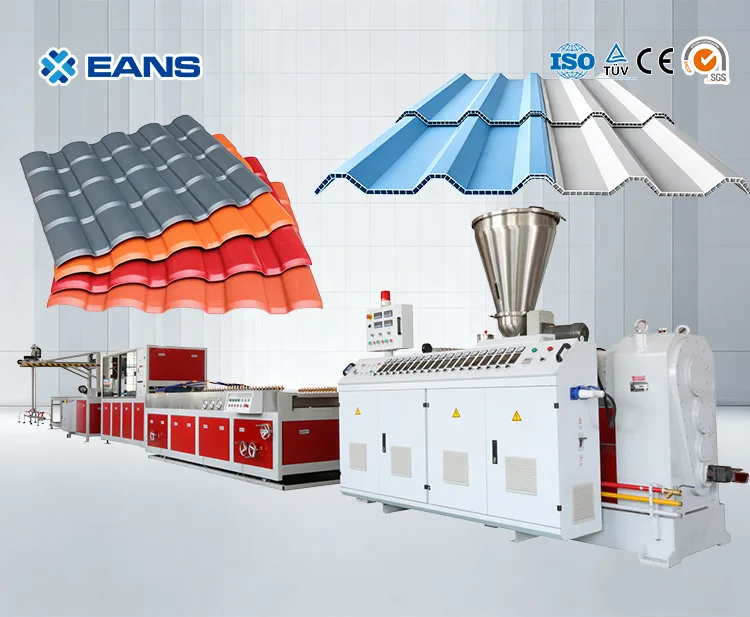
EANS Machine provides complete PE WPC decking extrusion solutions, including:
- High-speed heating and cooling mixers
- Parallel twin-screw pelletizing lines
- Conical twin-screw extrusion lines
- Vacuum calibration systems
- Haul-off and cutting machines
- Surface co-extrusion and embossing equipment
In addition to equipment supply, our engineers assist customers with formulation optimization, process parameter adjustment, and production commissioning to help achieve stable output, excellent product quality, and lower manufacturing costs.
Conclusion
PE is far more than just a plastic component in WPC boards. It serves as the structural matrix that binds wood fibers together while providing water resistance, toughness, weather durability, and stable extrusion performance. Choosing the right PE material and optimizing the formulation are essential steps toward producing premium WPC products with long service life and consistent quality.
As demand for sustainable outdoor building materials continues to grow, advanced PE WPC decking production line will remain the foundation of efficient and reliable manufacturing.