PVC Mixer Machine: Why Is Mixing Important Before Extrusion?
29 September, 2026
Starting a PVC marble sheet business takes four things: a PVC marble sheet production line built around a conical twin-screw extruder and a four-roll calender, a steady supply of PVC resin and calcium carbonate, a workshop of about 22 × 4 × 3.5 m for one line, and a working formula. A single SJZ80/156 line at 75 kW already puts out 10 tons per 24 hours, which is enough to run a real factory rather than a pilot line. The mistake most new buyers make is sizing the line to the cheapest quote instead of to the sheet width and thickness their local market actually buys.
PVC marble sheet sits in the decorative panel category alongside PVC wall panel and WPC board, but it sells on a different promise: the look of natural stone at a fraction of the weight and cost, with waterproof and B1 fire-retardant properties. This guide walks through what to buy, how to size it, and what the numbers look like before you sign.

Natural marble is heavy, needs skilled cutting, and fails in wet or humid rooms. PVC marble sheet copies the veining at over 99.5% simulation, bends around staircases, shrugs off water, and carries a 5H–7H surface hardness with a 3H scratch rating. Interior contractors use it for walls, ceilings, cabinet faces, and door frames, which means a factory sells into renovation, new build, and furniture channels at once. The demand side is stable; the risk is almost always on the production side — inconsistent thickness or poor surface replication kills repeat orders faster than price does.
Judge a marble sheet line on four numbers, not on the brochure photo. First, the maximum sheet width — 1220 mm covers most interior work, but 2000 mm opens ceiling and large wall panel jobs. Second, the thickness window: decorative sheets run 0.5–6 mm, and a line that covers both thin laminates and thick boards earns more orders. Third, the calender type — a four-roll calender with servo control holds flatness under 0.1 mm, which a cheap two-roll unit cannot. Fourth, UV surface treatment, because that is what delivers the 10-year yellowing resistance and the stone-like gloss. Skip any line missing the UV stage and you are selling a different, weaker product.
| Item | SJZ80/156 | SJZ92/188 |
|---|---|---|
| Main motor | 75 kW | 110 kW |
| Max panel width | < 1220 mm | < 2000 mm |
| Sheet thickness | 0.5–4 mm | 1.5–6 mm |
| Capacity | 10 t / 24 h | 12–15 t / 24 h |
| Footprint | 22 × 4 × 3.5 m | 24 × 4 × 3.5 m |
Both run the same three-stage process — twin-screw extrusion, four-roll calendering, UV treatment — and both take the one-click spec change that cuts changeover from 2 hours to 15 minutes with 1.2% material loss. Pick SJZ80/156 to enter the market at lower cost; pick SJZ92/188 when your orders include wide ceiling panels or thick boards and you want the 12–15 t daily output.
Machine capacity is quoted in tons per day, but you sell in square meters, so convert before you plan inventory. Use the sheet density:
Daily area (m²) = daily output (kg) ÷ (density kg/m³ × thickness m)
PVC marble sheet runs around 1450 kg/m³. An SJZ92/188 at 13 t/day making 3 mm sheet gives 13000 ÷ (1450 × 0.003) = 13000 ÷ 4.35 ≈ 2989 m² per day. At 0.5 mm laminate the same 13 t stretches to about 17,900 m², which is why thickness drives your real throughput more than the motor rating does. Price your quotes per m², not per ton, or you will undercharge on thin sheets and overcharge on thick ones.

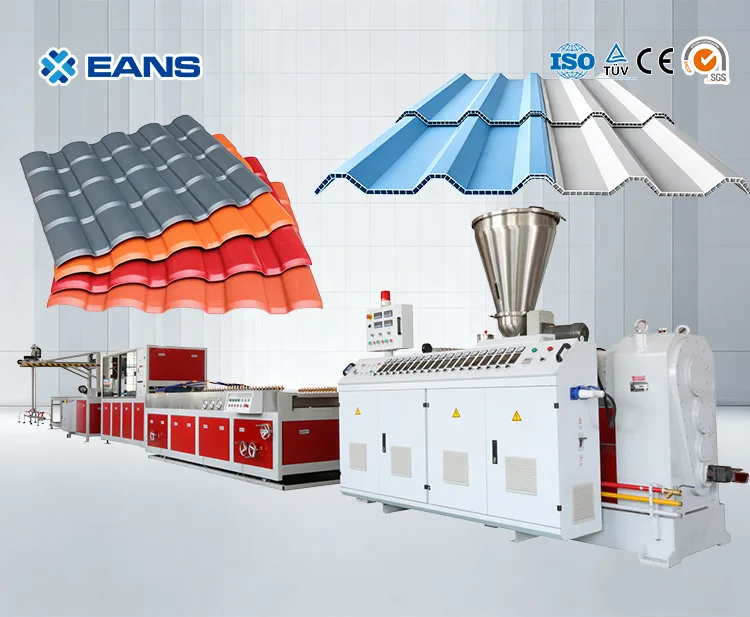
For a turnkey PVC marble sheet plant, EANS pairs the conical twin-screw extruder with a PLC system that holds barrel temperature to ±1°C and monitors extrusion pressure, roller speed, and die temperature on one screen. The four-roll calender uses heat-conducting oil control for online embossing and lamination, and the automatic stacker runs the line from extrusion to packing with about 60% less labor than a manual line. The real value for a first-time owner is the turnkey package: EANS supplies the workshop layout with land size, installation and consumption power, and water and compressed-air numbers, then customizes the PVC formula to your local raw material and market. Delivery runs 45–60 days. Pair the line with a high-speed PVC heating and cooling mixer (SRL-Z300/600 up to SRL-Z800/1600 by batch) so the compound hits 120°C and disperses evenly before it reaches the extruder.

No two plants are identical, but a standard first marble sheet line looks like this: one SJZ92/188 extrusion line with four-roll calender and UV unit, one SRL-Z mixer sized to the batch, a workshop near 24 × 4 × 3.5 m, and a formula tuned to local PVC resin and filler. The final configuration should be confirmed from the target sheet dimensions, required output, local raw materials, available workshop space, and utility conditions. Preparing the layout, utility figures, formula, and operator requirements before delivery removes much of the guesswork from a first factory.

At minimum: a conical twin-screw extruder with T-die, a four-roll calender with online lamination, a UV treatment unit, haul-off, cross cutter, and automatic stacker, plus a high-speed PVC heating and cooling mixer to prepare the compound. Ancillary items are a cooling water system, compressed air, and a dust-free cutting area.
One line occupies about 22 × 4 × 3.5 m for the SJZ80/156 or 24 × 4 × 3.5 m for the SJZ92/188. EANS supplies the exact installation power and running consumption power, plus land size, water, and compressed-air figures, as part of the turnkey layout so you size the building and the electrical connection before delivery.
Delivery runs around 45–60 days depending on configuration. Because EANS ships a turnkey plant with the workshop layout and formula already prepared, its installation, commissioning, and operator training support helps the line enter stable production more efficiently than buying loose machines from separate suppliers.
Yes. The line supports one-click spec switching that drops changeover from 2 hours to 15 minutes and keeps material loss at 1.2%. Pattern changes come from the lamination and UV transfer stage rather than the extruder, so you can run marble, stone, and wood looks on the same line by swapping the film and adjusting the formula.
The base is PVC resin with calcium carbonate filler, plus stabilizers, lubricants, and pigments, finished with lamination, transfer printing, and UV coating to copy the marble texture. EANS customizes the formula to the PVC resin and filler available in your country, which matters because filler quality changes both cost and surface quality.
Capacity lands at 400–750 kg/h, or 10–15 tons per 24 hours across the two line sizes. In area terms that is roughly 3,000 m² per day of 3 mm sheet on the larger line. Plan your inventory and pricing per square meter, since thickness changes the real throughput more than the motor rating.
Start by fixing the sheet width and thickness your local market buys, then size the line to that — SJZ80/156 for 1220 mm decorative sheet, SJZ92/188 for wide or thick board. Budget for the four-roll calender and UV stage as non-negotiable, pair the extruder with a properly sized mixer, and take the turnkey layout so power and water are settled before the machine lands. Send us your target width, thickness range, daily output, raw material information, and workshop conditions to request a customized PVC marble sheet production line proposal with the workshop layout, utility figures, and a formula tuned to your raw material.