PVC Mixer Machine: Why Is Mixing Important Before Extrusion?
29 September, 2026
PS wall panel, also known as charcoal louvers panel or PS fluted panel, is made primarily of HIPS high-impact polystyrene, combined with compatibility modifiers, UV-resistant additives, color masterbatches, and filler systems. It is produced by single-screw extrusion and integral extrusion using a shaping die to form long strip grating profiles, which are then cut and assembled into grating decorative panels.
PS wall panel production line employs continuous polymer extrusion molding processes. Any imbalance in parameters such as raw material fluctuations, temperature, screw speed, die pressure, or cooling and shaping can directly cause defects in the sheets. A PS wall panel production line is only as reliable as the technicians running it. From start-up debugging to defect control and cost savings, skilled personnel cut scrap rate, reduce downtime, and protect equipment—directly deciding whether your charcoal louvers panels ship on spec. This article explores the importance of technology in the charcoal louvers production process from the perspective of technical personnel, helping many PS wall panel manufacturers. Technical personnel play a crucial role in ensuring stable mass production, quality control, cost reduction, and efficiency improvement. Their value is primarily comprised of six key areas:

Process Parameter Setting: Based on the GPPS/HIPS raw material grade, sheet thickness, and width requirements, accurately set the temperature of each zone of the barrel, screw speed, melt pressure, die opening, three-roll calender temperature and gap, and traction speed. Excessive temperature can easily cause PS melt degradation, yellowing, and bubbles in the sheet; insufficient temperature can result in poor melt plasticization, surface pitting, and uneven stress.
Equipment Debugging: Adjust the extruder screw back pressure, die flow balance, hydraulic screen changer pressure, and three-roll parallelism. Common PS sheet thickness variations, such as thinner middle and thicker edges, and surface ripples, all require on-site fine-tuning by technicians of the die bolts and three-roll pressure.
Start-up Risk Management: PS material is prone to oxidation and yellowing at high temperatures. The start-up heating, cleaning, and shutdown heat preservation processes need to be controlled by technicians to avoid prolonged high-temperature material retention, which can lead to charred particles and black spots.
High-frequency defects in production are all resolved immediately by technical personnel:
Black spots and burnt particles on the sheet surface: Investigate screw buildup, die carbon buildup, raw material impurities, and filter aging; arrange for screen replacement and die cleaning.
Charcoal louvers bending and high internal stress: Optimize the temperature gradient of the cooling rollers and adjust the traction tension.
Excessive thickness tolerance, streaks, and melt lines: Adjust the die lip gap and balance the melt pressure.
Bubbles and pinholes: Control raw material dehumidification, utilize the extrusion vacuum system, and prevent raw materials from absorbing water.
Many defects in PS charcoal louvers render them waste once mass production begins. Technicians can quickly predict and mitigate these defects, directly reducing the scrap rate.
Differentiating between ordinary GPPS, impact-resistant HIPS, flame-retardant PS, and modified filled PS, the different raw materials exhibit significant differences in flowability, requiring a complete re-matching of the extrusion process;
Coordinating with color matching production (masterbatch/pigment boards), adjusting shear and temperature to resolve issues such as color difference, color texture, and poor dispersion;
Controlling the blending ratio of recycled materials and adjusting the process to offset fluctuations in the flowability of recycled materials, thereby stabilizing product quality.
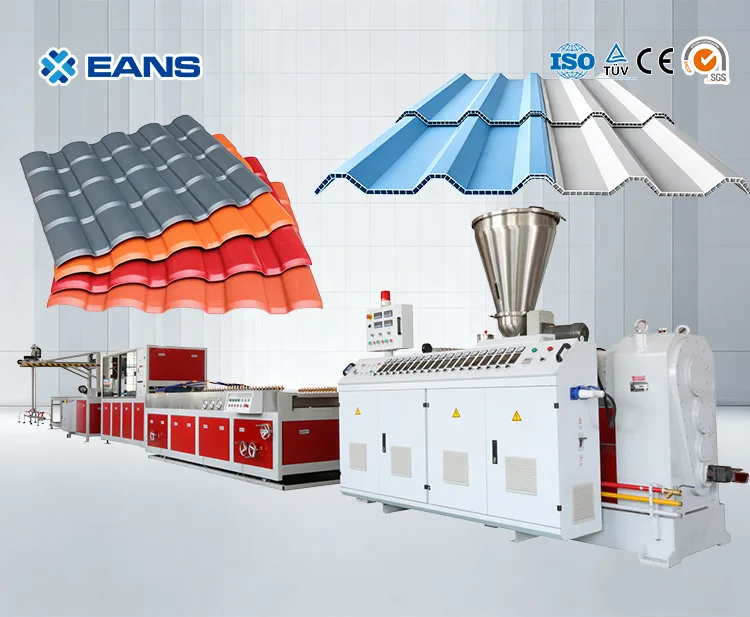
The single-screw PS wall panel production line shown in the diagram includes an extruder, co-extruder, die head, water cooling tank, hot stamping machine, hauling off, and cutting stacking unit:
Monitor the extruder current, melt pressure, and oil temperature to determine screw wear and screen blockage;
Standardize the cleaning process to prevent PS carbonization and corrosion of the screw and die head;
Predict faults in seals, hydraulic system, and temperature control system, and perform early maintenance to avoid sudden shutdowns;
Standardize the shutdown process to prevent melt solidification and die head blockage, significantly reducing cleaning time.

Optimize the process range to reasonably increase extrusion speed and boost single-line capacity while ensuring sheet quality;
Optimize the temperature range to reduce energy consumption; use filters appropriately to extend their lifespan and reduce consumable costs;
Reduce defective products and waste materials to improve yield. Skilled technicians can improve yield by several percentage points, resulting in significant long-term benefits.
Consolidate mature processes into Standard Operating Procedures (SOPs) to reduce quality fluctuations caused by personnel turnover;
Guide operators to operate in a standardized manner to avoid batch defects caused by incorrect operations;
Cooperate with R&D to develop special specifications of PS wall panel (thick sheets, thin sheets, frosted sheets, anti-static modified sheets), explore new process parameters, and achieve mass production of new products.
| Production Stage | Core Control Key Points | Acceptance Standard |
| Raw Material Preparation | Use virgin PS polystyrene granules; evenly mix charcoal pigment & anti-UV additives; strictly filter out impurities to avoid surface spots. | No recycled materials; zero visible impurity particles on panel surface. |
| Extrusion Forming | Stable temperature control; keep consistent panel thickness; prevent warping & internal bubbles; guarantee flat base substrate. | Thickness error ≤±0.3mm; no air bubbles, no bending deformation. |
| Surface Texture Molding | Precise mold pressure control; unified charcoal texture depth; clear continuous grain without broken pattern. | Texture consistent on all panels; no pattern fracture or distortion. |
| Surface Coating Treatment | Scratch-resistant topcoat; even matte charcoal finish; anti-fingerprint & moisture-proof performance; avoid color difference between batches. | No obvious color difference between batches; coating resistant to daily scratches. |
| Precision Cutting | CNC fixed-size cutting; smooth, burr-free edges; tolerance controlled within ±0.5mm for easy installation & seamless splicing. | Clean cut edges without burrs; dimensional tolerance ≤±0.5mm. |
| Quality Inspection | Check color uniformity, flatness, surface defects, size accuracy; defective products eliminated before packaging. | Strict 100% visual inspection before shipment. |
| Packaging | Individual protective film + carton packaging; avoid scratch and collision damage during sea transportation. | Complete film coverage; reinforced carton suitable for long-distance ocean shipping. |
PS charcoal wall panel extrusion is a continuous, multi-variable coupled process. Equipment is merely hardware; technical personnel master the core logic of the process. A lack of professional technical personnel can easily lead to: continuous production of defective sheets, frequent downtime for debugging, waste of raw materials and energy, and abnormal equipment wear and tear; a stable and experienced technical team is key to a factory’s stable supply and ensuring product competitiveness.
EANS supplies turnkey PS wall panel production line with full start-up commissioning and operator training. [Explore the PS wall panel extrusion line] or [contact our engineers] for a process audit.