The global PVC foam board market continues to expand, driven by demand from the construction, furniture, and advertising industries. For manufacturers and investors looking to enter this space, understanding the PVC foam board production process is the first critical step toward making informed equipment and operational decisions.
Unlike traditional solid plastic sheet manufacturing, PVC foam board production involves a sophisticated chemical foaming process that must be precisely controlled at every stage. From selecting the right raw materials to the final cutting and stacking, each step directly impacts board quality, production efficiency, and operating costs.
In this comprehensive guide, we walk through the entire PVC foam board manufacturing process — from raw material preparation to finished board — providing technical insights based on over two decades of extrusion equipment manufacturing experience.
Raw Material Selection and Preparation
The quality of any PVC foam board begins with its raw materials. The formulation, commonly referred to as “the recipe,” is the foundation of a successful production process. Industry experts estimate that the success of foam board production depends approximately 40% on the machine and 60% on the chemical formulation.
PVC Resin (K-Value 57-58)
PVC resin is the primary structural component of the foam board. For foam board applications, a K-value of 57-58 is typically recommended. This specific grade offers the optimal balance of melt flow and mechanical properties required for stable foaming.
Foaming Agents (AC and NC)
The foaming agent system is the heart of the PVC foam board production process:
| Agent Type |
Characteristic |
Function |
| AC (Azodicarbonamide) |
Exothermic — releases heat during decomposition |
Creates gas bubbles for foam structure |
| NC (Sodium Bicarbonate-based) |
Endothermic — absorbs heat during decomposition |
Refines cell structure, creates finer foam |
The precise balancing of these two agents is what separates high-quality foam boards from mediocre ones. A proper AC/NC ratio produces a fine, closed-cell foam structure with uniform density.
Foaming Regulator (Acrylic Processing Aid)
This is a critical but often overlooked component. A high-molecular-weight acrylic processing aid:
- Enhances melt strength so gas bubbles don’t collapse
- Improves surface finish quality
- Ensures uniform cell distribution throughout the board thickness
Calcium Carbonate (Filler)
Calcium carbonate serves dual purposes:
- Cost reduction — replaces more expensive PVC resin
- Increased rigidity — enhances board stiffness
However, excessive filler loading can compromise foam quality and mechanical properties. A well-optimized formulation maintains the right balance.
Other Additives
- Stabilizers (lead-based or calcium-zinc): Prevent PVC degradation during processing
- Lubricants (internal and external): Improve melt flow and release from metal surfaces
- Titanium dioxide: Provides whiteness and UV resistance
- Impact modifiers: Enhance toughness for applications requiring machining or routing
Raw Material Handling and Storage
Proper raw material management is essential for consistent production:
- PVC resin should be stored in a dry, cool environment (below 30°C)
- Calcium carbonate and other powders require sealed silos or containers
- Liquid additives must be stored at stable temperatures
- A centralized material handling system with automated weighing improves accuracy and reduces labor
High-Speed Mixing and Compounding
Once raw materials are selected, they enter the mixing stage. This is where the dry blend — also called the “dry blend” or “powder blend” — is prepared.
Hot Mixing (High-Speed Mixer)
The raw materials are loaded into a high-speed hot mixer operating at:
| Parameter |
Typical Value |
| Mixing Speed |
800–1200 RPM |
| Discharge Temperature |
110–120°C |
| Cycle Time |
5–8 minutes |
At these temperatures, the PVC resin particles absorb the liquid additives (stabilizers, plasticizers) and the solid additives are uniformly dispersed. The foaming agents and regulator are evenly distributed throughout the PVC matrix.
Cold Mixing (Low-Speed Cooler)
After hot mixing, the blend must be rapidly cooled to:
- Discharge Temperature: 40–50°C
- Cooling Time: 8–12 minutes
Rapid cooling prevents the premature decomposition of foaming agents and “cakes” the blend into a free-flowing powder. The resulting dry blend is ready for extrusion and can be stored for 24–48 hours before use.
Pro Tip: Proper mixing parameters are essential. Overheating can activate foaming agents prematurely, while under-mixing results in poor dispersion and inconsistent board quality.
Conical Twin-Screw Extrusion
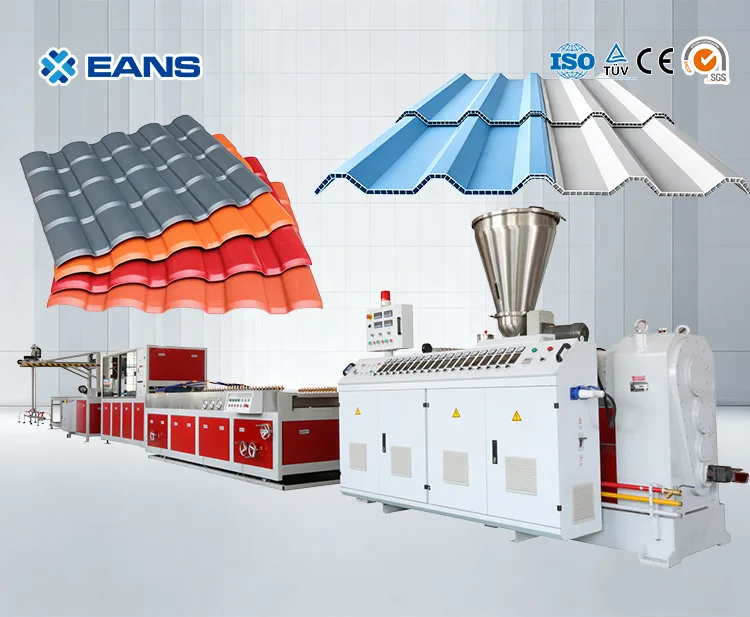
The extrusion stage is where the dry blend transforms into a molten, foamable material. A conical twin-screw extruder is the industry standard for PVC foam board production due to its superior:
- Vacuum degassing — removes moisture and volatiles, preventing internal voids
- Low shear heat generation — protects heat-sensitive PVC and foaming agents
- High throughput — enables production rates of 400–600 kg/hour
Extrusion Temperature Profile
The barrel temperature zones are precisely controlled to:
| Zone |
Temperature Range |
Purpose |
| Feed Zone |
165–175°C |
Gentle heating, material conveying |
| Compression Zone |
175–185°C |
Melting and plastication |
| Metering Zone |
180–190°C |
Homogenization, temperature equalization |
| Die Adapter |
175–185°C |
Temperature adjustment before die entry |
Screw Design Considerations
The twin-screw geometry is specifically designed for foam applications:
- Conical design provides increasing compression ratio
- Special mixing elements ensure uniform additive dispersion
- Vacuum vent port located at approximately 60-70% of screw length
- Chrome-plated screw surface for corrosion resistance
The screw speed typically ranges from 20–35 RPM, depending on the formulation and desired output rate.
Melt Filtration and Die Flow
Screen Changer
Before entering the die, the molten PVC passes through a screen changer that:
- Removes unmelted particles and contaminants
- Creates backpressure for better melt uniformity
- Allows continuous operation without stopping for screen changes (hydraulic type)
T-Die Design and Function
The T-die is one of the most critical components in the PVC foam board production process:
| Feature |
Specification |
Benefit |
| Material |
P20 mold steel, hardened |
Wear resistance, long service life |
| Thickness Range |
5–30 mm (adjustable lip) |
Versatile production capabilities |
| Coating |
Chrome-plated cavity |
Corrosion resistance, smooth melt flow |
| Flow Design |
“Balanced flow” manifold |
Uniform melt distribution across width |
The balanced flow manifold design ensures that the molten PVC reaches the center and edges of the die at the same velocity and pressure. Poor die design leads to density variations across the board width — a common problem with lower-quality production lines.
The Foaming Process
The actual foaming begins as the melt exits the die and enters the calibration unit. This is where the magic — and the science — of foam board production happens.
Celuka Method (Crust Foam) vs. Free-Foam Method
| Aspect |
Celuka Method |
Free-Foam Method |
| Surface |
Hard, smooth, gloss “skin” |
Soft, matte surface |
| Core |
Foamed interior |
Solid/foamed throughout |
| Density |
0.4–0.6 g/cm³ (overall) |
0.6–0.8 g/cm³ (uniform) |
| Best for |
Furniture, construction |
Advertising, signage |
| Process |
Surface cooled immediately at die exit |
Free expansion after die |
The Celuka method (also called “crust foam”) is the preferred technology for high-quality PVC foam boards. As the melt exits the die, the surface is immediately cooled by the calibration system, forming a dense, hard skin while the interior continues to foam. This creates a board with:
- Excellent surface hardness (scratch-resistant)
- Smooth finish suitable for painting, laminating, or printing
- Lightweight core with good impact resistance
- Dimensional stability under temperature variations
Foam Cell Structure Control
Achieving a uniform, fine-cell foam structure requires precise control of:
- Temperature: ±1°C accuracy across all zones
- Pressure: Consistent die pressure (typically 150-250 bar)
- Throughput: Stable extruder output rate
- Cooling rate: Controlled temperature gradient in calibration
A well-controlled process produces foam cells in the range of 50-150 microns, resulting in optimal mechanical properties.
Calibration and Cooling
Hydraulic Calibration Table (Hydraulic Calibration Table)
Eans Machinery‘s hydraulic calibration table offers significant advantages over electric-type systems:
| Feature |
Hydraulic System |
Electric System |
| Pressure Stability |
Excellent, continuous |
Variable, less stable |
| Board Flatness |
Superior, especially for thick boards |
Good for thin boards |
| Mold Change |
Quick, one-button thickness switching |
Time-consuming manual adjustment |
| Maintenance |
Lower |
Higher |
The calibration table houses four sets of calibration molds that define the final dimensions of the foam board. The hydraulic system maintains consistent pressure across the full board width, ensuring:
- Uniform thickness (±0.1mm tolerance)
- Flat, warp-free surface
- Consistent density distribution
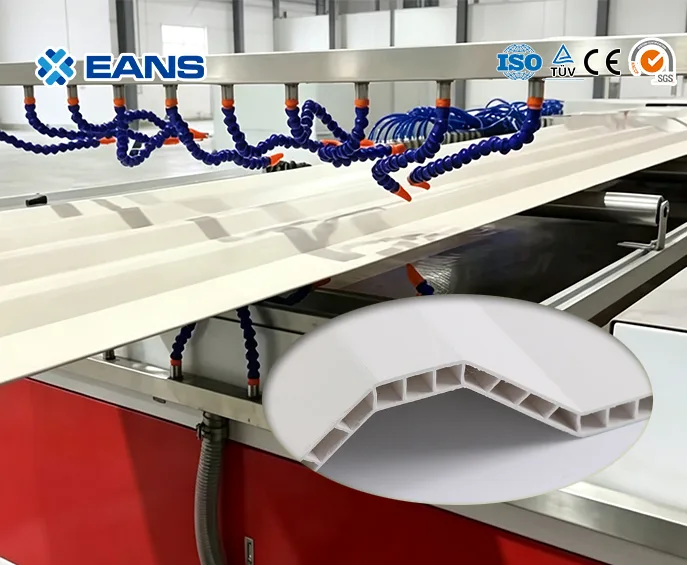
Cooling System
The cooling section typically consists of multiple cooling tanks with:
- Spray cooling for uniform temperature reduction
- Roller support system to prevent board sagging
- Variable speed control to match production rate
- Water temperature control (15–25°C) for consistent cooling
Proper cooling is essential — insufficient cooling results in board warpage, while excessive cooling can cause internal stresses.
Traction and Cutting
Haul-off / Traction Unit
The traction unit pulls the foam board through the production line at a consistent speed. Key features:
- Gear-driven transmission (superior to chain drive)
- 8 pairs of rubber rollers for even grip
- Anti-slip surface prevents board marking
- Servo motor control for precise speed matching
The traction speed must be precisely synchronized with the extruder output to maintain consistent board thickness and density.
Servo Cutting System
The cutting station performs two critical functions:
- Length cutting: Servo-controlled saw travels with the board for precise length accuracy (±1mm)
- Edge trimming: Dual-blade synchronized trimming removes irregular edges
- Dust collection: Integrated system keeps the working environment clean
Available cutting methods:
| Method |
Best For |
Accuracy |
| Servo traveling saw |
Standard sheet production |
±1mm |
| Guillotine cutter |
High-speed thin board |
±2mm |
Stacking, Inspection, and Packaging
Automatic Stacking
Modern PVC foam board production lines feature automatic stacking systems that:
- Count boards automatically
- Stack with protective interlayers
- Integrate with quality checking stations
Quality Control Checks
Before packaging, finished boards undergo:
| QC Parameter |
Standard Range |
Testing Method |
| Density |
0.4–0.8 g/cm³ |
Sample weighing |
| Thickness |
±0.2mm |
Digital caliper |
| Surface hardness |
Shore D 60-75 |
Durometer test |
| Warpage |
<1mm/m |
Flat surface test |
| Dimensional stability |
<2% change at 60°C |
Oven test |
Packaging
Standard packaging includes:
- PE film wrapping for moisture protection
- Cardboard edge protection
- Pallet strapping for safe transport
- Export-grade packaging for international shipping
Production Line Technical Specifications
For reference, here are the specifications of Eans Machinery‘s standard PVC foam board production lines:
| Parameter |
SJ80/156 |
SJ92/188 |
| Board Width |
1220×2440 mm |
1560×2440 mm |
| Thickness Range |
3–20 mm |
3–30 mm |
| Extruder Motor |
75 KW |
110 KW |
| Daily Capacity |
10 tons/24hrs |
15 tons/24hrs |
| Suitable For |
Standard furniture boards |
Large-format construction boards |
Frequently Asked Questions
What is the difference between PVC foam board and solid PVC sheet?
PVC foam board has a cellular core structure created by foaming agents, making it 30-50% lighter than solid PVC sheet of the same thickness. Foam boards offer better thermal and sound insulation, while solid sheets provide higher mechanical strength.
Can the same production line produce both Celuka and Free-Foam boards?
Yes. With die adjustment and formulation changes, most modern PVC foam board production lines can switch between Celuka and Free-Foam methods. However, Celuka requires additional calibration cooling capacity.
How long does it take to change from one board thickness to another?
With a hydraulic calibration table like Eans Machinery’s system, thickness changes can be completed in approximately 15-30 minutes with one-button adjustment. Traditional manual systems may take 2-3 hours.
What causes bubbles or voids in PVC foam board?
Internal voids are typically caused by: (1) moisture in raw materials, (2) improper vacuum degassing, (3) imbalanced AC/NC foaming agent ratio, or (4) incorrect temperature profile. Regular QC checks help identify and resolve these issues.
What is the minimum investment for setting up a PVC foam board production line?
Investment varies significantly based on line configuration, automation level, and board width. The Eans Machinery team can provide a detailed quotation based on your specific production requirements and budget.
Does the formulation need to change for different board colors?
Yes. Different pigments can affect the foaming process. White and light-colored boards are typically easiest to produce, while dark colors may require formulation adjustments to compensate for heat absorption differences.
How much factory space is needed for a complete PVC foam board production line?
A standard line requires approximately 600-800 square meters of production space, including raw material storage, production area, and finished product storage. Eans Machinery provides free factory layout consulting with every line purchase.
What training does Eans Machinery provide for operators?
We provide comprehensive on-site training covering raw material formulation, machine operation, maintenance procedures, and quality control. Our technical team also provides remote support for ongoing operational questions.
Conclusion: From Raw Materials to Market-Ready Boards
The PVC foam board production process is a sophisticated blend of material science and precision engineering. From the careful selection of raw materials to the final inspection of finished boards, each stage demands attention to detail and proper equipment.
With over 20 years of experience in plastic extrusion, Eans Machinery provides complete turnkey solutions for PVC foam board production — from equipment selection and factory layout to formulation support and operator training.
Contact our technical team to discuss your production requirements and learn how our PVC foam board production lines can help you produce high-quality boards efficiently and cost-effectively.
This article is part of Eans Machinery‘s Technical Knowledge Series. For more information, explore our PVC Foam Board Production Line product page or read our Complete Manufacturing Guide for PVC Foam Board Production Line.