PVC Mixer Machine: Why Is Mixing Important Before Extrusion?
29 September, 2026
A PVC marble sheet factory should not begin with an extruder model. It should begin with a saleable sheet specification. Panel width, thickness, density, surface finish, daily demand, raw materials, and quality limits determine the process route and equipment configuration. If these items remain unclear, a buyer may receive a line that produces sheet but does not produce the required finished panel efficiently.
This guide is for factory engineers and purchasing managers planning a new workshop or expanding an existing plant. It connects the finished product with the manufacturing route, raw-material system, equipment scope, output, energy evaluation, factory layout, and acceptance test. Readers who need a product-level introduction can first review what PVC marble sheet is and where it is used.
The same line cannot be evaluated correctly without a defined product range. Prepare a product matrix instead of sending only a sample or a general request for a 1220 mm sheet.
| Product Details | Information to confirm | Why it affects the line |
|---|---|---|
| Dimensions | Width, thickness range, cut length, and tolerances | Sets the die, calender, cooling, haul-off, and cutter sizes |
| Sheet structure | Base sheet, decorative film, embossing, UV coating, and protective film | Determines whether finishing machines are required |
| Material target | Density, filler level, color, stiffness, and test standard | Changes plasticization, screw load, cooling, and attainable output |
| Commercial format | Pieces or square metres per day, pattern mix, packaging, and pallet size | Connects extrusion output to saleable production and warehouse flow |
Separate mandatory products from future products. A wider or thicker future sheet may require a different extruder, die, calender, and building arrangement. Paying for unused width also increases investment and may reduce efficiency on the products that form most orders.

PVC marble sheet manufacturing normally contains two connected sections: base-sheet extrusion and decorative surface finishing. A base-sheet plant stops after forming, cooling, cutting, and stacking. A finished-panel plant may also need film lamination, embossing, UV coating, curing, protective-film application, inspection, and packing.
Dry blend is fed into a conical twin-screw extruder, plasticized, distributed through a T-die, formed by the calender, cooled, hauled, trimmed, cut, and stacked. This route is suitable when decoration is completed elsewhere or when the factory sells unfinished sheet.
This route adds the surface operations required by the target product. Some decorative films can be laminated while the sheet is hot. UV coating is often arranged as a separate finishing line because coating, curing, ventilation, surface inspection, and handling have their own operating conditions. The quotation should state whether each finishing unit is included, optional, or supplied by another company.
The purchase boundary should also identify chillers, cooling towers, air compressors, material conveying, dust collection, water piping, electrical cables, laboratory tools, lifting equipment, spare parts, and installation materials. The words “complete line” are not a substitute for an itemized scope. EANS presents the connected process in its turnkey PVC marble sheet plant solution, but the final boundary still needs project-specific confirmation.
The dry blend generally contains PVC resin, calcium carbonate, stabilizers, lubricants, processing aids, pigments, and other additives selected for the required sheet. Decorative film, UV coating, and protective film belong to the surface system. Their compatibility with the base sheet and process temperature must be tested.
There is no reliable universal formula for every factory. Resin grade, calcium carbonate particle properties, moisture, filler loading, additive system, sheet thickness, and local climate can change processing behavior. A formula that runs on one screw design may need adjustment on another.
Raw materials should be weighed consistently and dispersed before extrusion. A PVC heating and cooling mixer for dry-blend preparation must match the extruder demand and the actual batch cycle. The cooling stage is important because feeding hot or agglomerated blend can reduce feeding stability. Buyers should confirm mixer working volume, cycle time, discharge temperature, material-transfer method, and cleaning access.
Metered ingredients are hot mixed for dispersion, then cooled and transferred to a storage or feeding unit. Batch records help operators trace changes in color, output, or sheet quality.
The extruder conveys, heats, mixes, vents, and plasticizes the PVC compound. Feed rate, screw speed, barrel temperature, vacuum, melt pressure, and motor load must remain within a stable operating window. Excessive heat can degrade PVC; incomplete plasticization can cause rough surfaces and unstable physical properties.
The T-die spreads the melt across the sheet width. The calender controls thickness, surface, and flatness through roller gap, temperature, pressure, and speed synchronization. EANS lists a four-roll calender on its current PVC marble sheet production line. The die, calender, and haul-off should be treated as one matched system rather than selected separately.
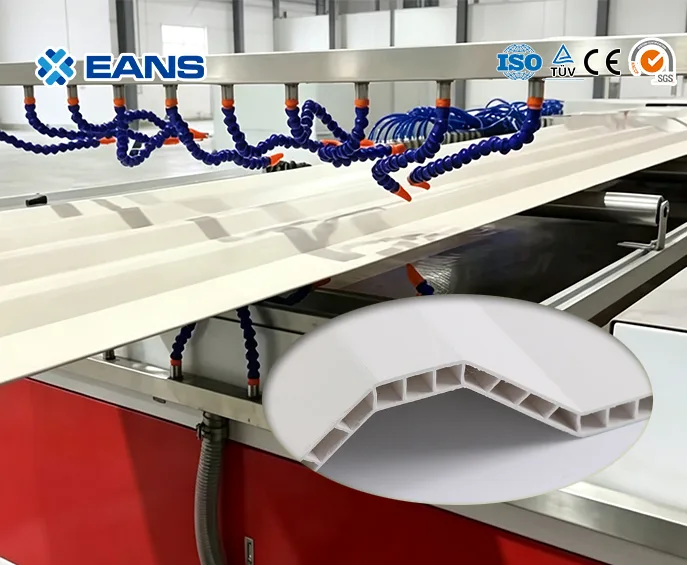
The hot sheet is cooled under controlled tension. Edge trimming removes unstable sides, the cutter produces the specified length, and the stacker receives the panels without damaging the surface. Sheet temperature at stacking matters because panels can deform if they retain uneven heat.
Decorative film and embossing create the visual pattern and texture. UV coating controls gloss and protects the printed surface according to the selected coating system. Curing conditions, ventilation, coating compatibility, protective-film application, and packaging must be included in the plant plan, even when finishing is offline.

| Section | Typical equipment | Buyer decision |
|---|---|---|
| Raw materials | Weighing, hot/cold mixer, conveying, and storage | Batch size, automation level, dust control, and formula-change procedure |
| Extrusion | Conical twin-screw extruder, feeder, vacuum, and T-die | Material, width, thickness, output, motor, screw design, and tooling |
| Forming | Four-roll calender, temperature control, lamination, and cooling | Surface process, roller width, tolerance, cooling load, and changeover |
| Downstream | Haul-off, trimming, cutter, stacker, and waste handling | Cut length, edge quality, line speed, sheet handling, and recycling boundary |
| Finishing | UV coater, curing, protective film, inspection, and packing | Gloss, coating, pattern mix, ventilation, floor space, and offline storage |
EANS publishes two configurations for different panel ranges. The figures below are listed equipment specifications. Actual saleable output depends on the formula, sheet dimensions, surface process, operating time, changeovers, scrap, and acceptance standard.
| Parameter | SJZ80/156 | SJZ92/188 |
|---|---|---|
| Applicable panel width | <= 1220 mm | <=Below 2000 mm |
| Sheet thickness | 1–4 mm | 1.5–6 mm |
| Main motor | 75 kW | 110 kW |
| Listed capacity | 10 tons per 24 hours | 12–15 tons per 24 hours |
| Listed line dimensions | 22 × 4 × 3.5 m | 24 × 4 × 3.5 m |
Convert the sales plan into good product rather than comparing only kilograms per hour. Required sheet area can be calculated from good-product mass divided by actual sheet density and thickness. Then allow for start-up scrap, edge trim, pattern changes, maintenance, and planned operating hours. Ask the supplier for expected output on the main product specification and agreed formula.
The 75 kW or 110 kW figure in the table is the main extruder motor rating, not the total line consumption. Factory electrical planning must include the mixer, heaters, calender drives and temperature control, haul-off, cutter, stacker, chillers or pumps, air compressor, UV finishing, ventilation, material handling, and lighting.
Compare three different values:
A useful energy comparison states the meter boundary, product thickness, formula, output, start and stop time, scrap treatment, cooling conditions, and whether the UV line and auxiliaries are included. Without this boundary, two energy figures may describe different systems.
The listed machine footprint is not the required workshop size. Plan a one-way material flow from raw-material receiving to mixing, extrusion, finishing, inspection, packing, and finished-goods storage. Provide safe aisles, lifting access, die-removal space, electrical-cabinet clearance, roll and film storage, maintenance zones, and a route for removing scrap.
Keep dusty weighing and mixing operations controlled, while UV coating and curing require suitable ventilation and chemical-handling arrangements. Confirm foundation loads, floor level, ceiling height, power supply, cooling-water quality and temperature, compressed-air pressure and flow, drainage, and local environmental requirements before fixing the layout.

A factory test should prove the agreed product, not only that each motor runs. Attach the acceptance conditions to the technical agreement.
Record actual settings and results during the trial. These records provide a useful starting point for commissioning at the buyer’s factory and make later troubleshooting more systematic.
No. The usable range is limited by the extruder, die, calender, downstream width, cooling capacity, and process stability. Confirm the complete product matrix before model selection.
Not automatically. UV finishing may be a separate line. The quotation should state the coating, curing, ventilation, handling, and protective-film equipment included in the supply.
Compare accepted kilograms, sheets, or square metres per hour for a named formula and sheet specification. Maximum extruder output alone does not show finished-panel production.
Provide the target formula, sheet dimensions, output, operating hours, utilities, and finishing scope. Ask for installed power, estimated operating load, and the measurement boundary separately.
Send product drawings, samples, width and thickness range, density, raw-material information, daily good-output target, surface process, workshop dimensions, utility conditions, destination, and acceptance requirements.
A sound PVC marble sheet project connects product specifications, formula, extrusion, finishing, utilities, layout, output, energy, and acceptance in one technical plan. This prevents hidden scope gaps and gives engineering and purchasing teams a common basis for comparing quotations.
To prepare a project-specific configuration, send EANS your main sheet specifications, expected product mix, raw materials, output target, workshop drawing, local power standard, and required finishing process. You can then request a PVC marble sheet line proposal covering equipment scope, layout, utilities, tooling, service, and items that require material testing.