PVC Mixer Machine: Why Is Mixing Important Before Extrusion?
29 September, 2026
PVC profiles are manufactured by preparing a PVC dry blend, plasticizing it in an extruder, forming the required cross-section through a die, calibrating and cooling the profile, pulling it at a controlled speed, and cutting it to length. Depending on the finished product, punching, printing, hot stamping, or lamination can be added as secondary processing steps.
A stable PVC profile manufacturing process depends not only on the extrusion sequence but also on raw material formulation, mold design, cooling control, and production line configuration. This guide explains each production stage, the key equipment involved, quality control considerations, and the factors manufacturers should evaluate when selecting a PVC profile production line.
What Is the PVC Profile Manufacturing Process?
PVC Profile Manufacturing Process PVC profile manufacturing is a continuous extrusion process that converts PVC dry blend into precise rigid profiles through mixing, twin-screw extrusion, die forming, vacuum calibration, cooling, haul-off, and automatic cutting.
Whether manufacturing UPVC window profiles, door frames, cable ducts, skirting boards, or decorative trims, product quality depends not only on the extrusion process itself but also on the right material formulation, properly matched molds, and correctly configured production equipment.
Common PVC Profile Applications:

What Materials Are Used to Manufacture PVC Profiles?
PVC profiles are manufactured from a carefully formulated PVC compound rather than pure PVC resin alone. Because rigid PVC is highly sensitive to heat during processing, manufacturers combine resin with functional additives to improve thermal stability, plasticization, impact resistance, weather resistance, and extrusion performance before production begins.
In industrial production, material selection should be determined after confirming the profile cross-section, wall thickness, and application requirements. A multi-chamber UPVC window profile requires different processing characteristics from a cable duct or decorative trim, so the formulation, mold, and production line should be matched before manufacturing starts.

Material Preparation Checklist Before Extrusion:
Before feeding materials into the extruder, manufacturers should confirm:
A stable and well-prepared PVC compound provides the foundation for consistent plasticization, accurate profile dimensions, and efficient production in the next stage of the manufacturing process.
Typical Materials Used in PVC Profile Manufacturing:
The following materials are commonly used to produce rigid PVC profiles.
|
Material |
Primary Function |
|---|---|
| PVC Resin | Forms the primary polymer base of the profile. |
| Calcium Carbonate (CaCO₃) | Reduces material cost and increases rigidity when properly formulated. |
| Heat Stabilizer | Protects PVC from thermal degradation during extrusion. |
| Processing Aid | Improves melt flow and plasticization. |
| Impact Modifier (CPE or ACR) | Increases toughness and impact resistance. |
| Titanium Dioxide | Improves UV resistance, weatherability, and color stability. |
| Internal & External Lubricants | Balance plasticization while reducing friction inside the barrel and die. |
Step-by-Step PVC Profile Production Process:
The PVC profile manufacturing process is a continuous extrusion process in which formulated PVC dry blend is converted into a precise, stable profile through controlled heating, plasticization, die forming, calibration, cooling, haul-off, and cutting. Each stage must be properly matched with the next because changes in feeding rate, melt temperature, extrusion speed, cooling efficiency, or haul-off speed can directly affect profile dimensions, surface quality, and production stability.
1. Raw Material Batching and Mixing
PVC profile production starts with accurate batching of PVC resin, calcium carbonate, heat stabilizer, processing aids, impact modifiers, titanium dioxide, and internal or external lubricants according to the selected formulation.
The materials are first hot-mixed to distribute additives and fillers uniformly, typically at around 115–120°C. The mixture is then transferred to a cooling mixer and cooled to approximately 40–45°C before extrusion. Proper hot and cold mixing is important because an uneven dry blend can cause inconsistent plasticization, color variation, surface defects, and unstable extrusion.
For profiles using a high calcium carbonate loading, mixing quality becomes even more important because the filler must be evenly dispersed throughout the PVC compound.
2. Vacuum Feeding to the Extruder
After mixing, the prepared PVC dry blend is transferred to the extruder hopper through an automatic vacuum feeding system. Stable feeding ensures that the extruder receives a consistent amount of material throughout production.
Feeding fluctuations can lead to changes in extrusion pressure and output, which may subsequently affect profile dimensions and wall thickness. For continuous PVC profile production, automatic feeding is therefore preferred over manual material charging.
3. PVC Melting and Plasticization
Rigid PVC and uPVC profiles are commonly processed using a counter-rotating conical twin-screw extruder. The screws transport, compress, heat, and plasticize the dry blend while maintaining controlled material residence time.
Because PVC is sensitive to excessive heat, the barrel is divided into multiple temperature zones. The heating and cooling system works together to maintain a stable processing temperature. The objective is not simply to increase temperature, but to achieve sufficient plasticization without causing thermal degradation.
Poor plasticization may result in rough surfaces, weak weld lines, or unstable output, while excessive temperature or residence time can cause discoloration and material degradation.
4. Die Extrusion and Profile Forming
Once the PVC compound reaches a uniform melt state, it passes through the adapter and enters the profile die. The die determines the basic cross-sectional shape of the finished product, including its width, height, wall thickness, chambers, ribs, grooves, and other functional features.
The die must be designed according to the specific profile drawing and material formulation. Melt flow must be balanced across different sections of the die to minimize dimensional variation and uneven wall thickness.
At this stage, die temperature, extrusion pressure, melt flow, and screw speed must be coordinated to achieve stable profile formation.

5. Vacuum Calibration and Cooling
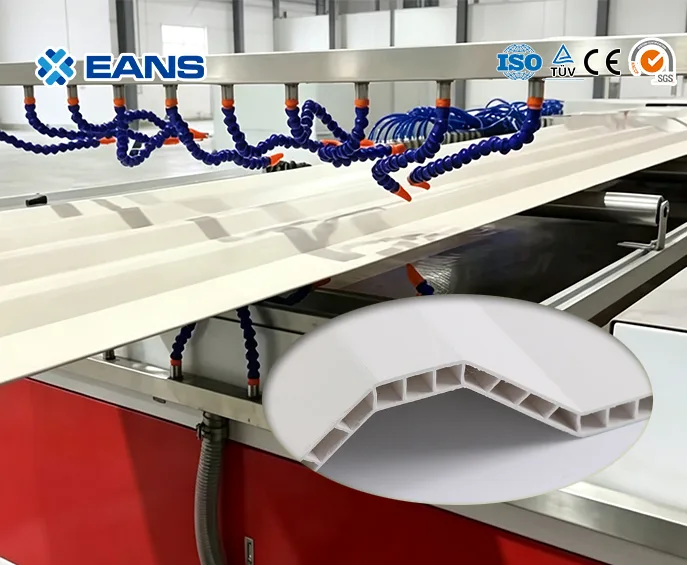
The hot profile leaving the die is still soft and cannot maintain its final dimensions by itself. It therefore enters a vacuum calibration table, where vacuum pressure draws the profile against the calibration tooling while cooling water removes heat.
The calibration tooling determines the final external dimensions and geometry of the profile. Vacuum stability, water temperature, cooling capacity, and calibration accuracy all influence dimensional stability.
For large or complex PVC profiles, sufficient calibration length and effective cooling are particularly important because inadequate cooling can cause deformation, shrinkage, twisting, or dimensional changes after leaving the calibration section.

6. Haul-Off and Online Film Lamination
After calibration and cooling, the profile enters the haul-off unit. The haul-off continuously pulls the profile through the downstream section at a controlled speed.
The haul-off speed must match the actual extrusion output. If the profile is pulled too quickly, wall thickness may decrease and residual stress can increase. If the speed is too low, material may accumulate or the profile may become difficult to maintain dimensionally.
For decorative or window profiles requiring surface protection, an online film laminating system can apply protective film during continuous production, reducing scratches and handling damage.
7. Automatic Cutting and Stacking
The cooled profile is transferred to an automatic cutting machine, where it is cut into the required commercial lengths, commonly according to the customer’s packaging and application requirements.
A travelling or dust-free saw cutter can synchronize its movement with the profile speed, allowing cutting without stopping the extrusion process. Automatic length control improves production efficiency and reduces manual handling.
After cutting, profiles can be transferred to a stacking or collection system for inspection, packaging, and storage.
8. Process Synchronization for Stable Production
A stable PVC profile production line depends on the synchronization of the entire process rather than the performance of a single machine. Material feeding, screw speed, barrel temperature, die pressure, vacuum calibration, cooling, haul-off speed, and cutting length must operate as an integrated system.
For manufacturers producing different PVC profile designs on the same line, process parameters and downstream tooling may need to be adjusted when changing products. The extrusion die and corresponding calibration tooling must also match the new profile geometry.
This is why selecting a PVC profile production line should be based on the complete product range, target output, formulation, profile dimensions, and required production speed—not simply the extruder model.
Machine Configuration That Matters
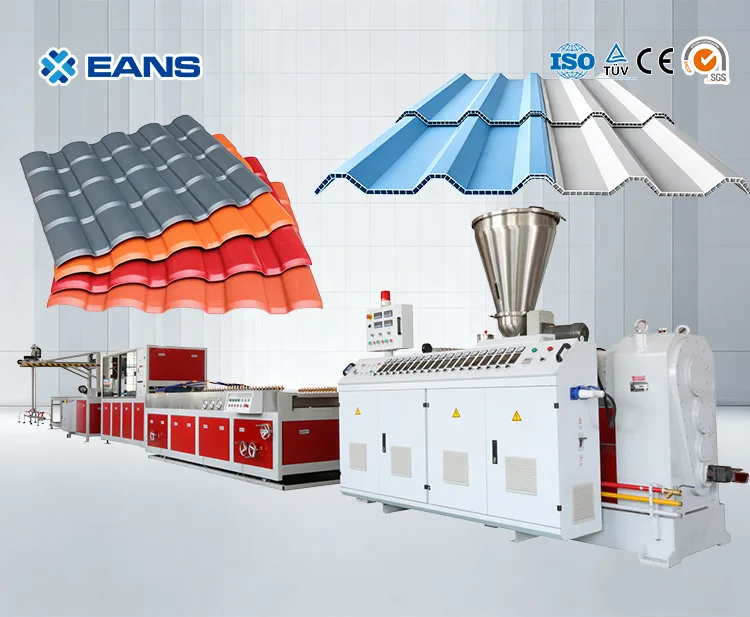
A stable PVC profile production line depends on how the main extrusion and downstream equipment are matched to the profile and material formulation. The following configurations have the greatest influence on production stability, profile quality, and equipment service life.
• Conical Twin-Screw Extruder
Rigid PVC profiles are typically processed with a counter-rotating conical twin-screw extruder. Select the conical twin-screw extruder according to profile size, formulation, and target output. Matching capacity improves production stability and avoids unnecessary investment.
• Screw and Barrel
Screw and barrel material is particularly important when processing high-CaCO₃ PVC formulations. Abrasive fillers increase wear, so wear-resistant alloy or bimetallic components can provide longer service life and more stable processing than standard components.
• Profile Die and Vacuum Calibration
The die determines the profile geometry, while the vacuum calibration system controls the final dimensions. For hollow, thin-wall, or complex profiles, balanced melt distribution, stable vacuum, adequate cooling, and accurate calibration tooling are essential for maintaining dimensional consistency.
• Haul-Off and Cutting
The haul-off must maintain stable traction and synchronize with extrusion output. An automatic travelling cutter can then cut profiles to consistent lengths without interrupting continuous production.
• Control System
PLC-based control integrates temperature, screw speed, vacuum, haul-off, and cutting parameters, making process adjustment and monitoring more consistent.
The key is system matching—not simply selecting a larger extruder. The engineers configure the extrusion, tooling, calibration, haul-off, and cutting systems according to the profile drawing, formulation, target output, and product range.
How to Choose a PVC Profile Production Line?
Choosing a PVC profile production line should be based on the profile specifications, target output, material formulation, and product range rather than the extruder model alone.
1. Define the Profile Specifications
Provide the manufacturer with the profile drawing, including width, height, wall thickness, chamber structure, and required length. Complex or large profiles may require greater extrusion capacity, longer calibration sections, and stronger downstream equipment.
2. Determine the Target Output
Define the required production capacity in kg/h or tons per day. The target output determines the appropriate extruder size, screw configuration, haul-off speed, cooling capacity, and cutting system. Equipment should be selected according to actual production requirements rather than maximum theoretical capacity.
3. Consider the PVC Formulation
The formulation directly affects extrusion performance and equipment wear. Standard PVC compounds and high-CaCO₃ formulations may require different screw, barrel, and die configurations. If a high filler loading is planned, wear-resistant components should be considered from the beginning.
4. Plan for Your Product Range
If the factory will produce several PVC profiles, select a production line with sufficient capacity and flexibility for the intended product range. Within its designed operating range, one line can produce different profiles by changing the extrusion die and corresponding calibration tooling and adjusting the process parameters.
5. Match the Complete Line
The complete line should be selected as an integrated system, where the extruder, die, calibration table, cooling, haul-off, and cutting units are matched to the profile dimensions, formulation, and required output.
For a PVC profile project, The engineers can recommend and configure the complete extrusion line based on the profile drawing, target capacity, material formulation, product range, and local production requirements.
Different PVC profiles require different die designs, calibration tooling, and downstream configurations. Common PVC profile production lines include complete PVC profile extrusion solutions for a wide range of applications, including:
Each production line can be configured according to the target profile dimensions, output requirements, formulation, and local market conditions. The selection of the extruder, die, vacuum calibration table, haul-off, cooling system, and cutting unit should therefore be based on the actual product rather than using a standard configuration for every application.
One Production Line, Multiple PVC Profile Products
Within its designed capacity range, one PVC profile production line can manufacture different profiles by changing the extrusion die and corresponding calibration tooling. Process parameters such as screw speed, temperature, vacuum level, and haul-off speed should then be adjusted to match the new profile.
This allows one production line to support multiple products instead of requiring a completely separate line for every profile design. However, the new profile must remain within the extruder capacity, calibration table dimensions, haul-off capability, and other equipment limits.

EANS Customized PVC Profile Extrusion Solutions
There is no universal PVC profile production line that is suitable for every factory. EANS engineers develop the extrusion line configuration according to your actual product requirements, target output, material formulation, profile dimensions, and local market needs. Based on these factors, the appropriate extruder, profile die, calibration system, haul-off, cutting equipment, and other auxiliary units can be selected to build a production line that is suitable for your intended production capacity and product range.
For manufacturers planning to produce multiple PVC profiles, the key is not simply choosing a larger machine, but matching the mold, extrusion capacity, and downstream equipment to the products you intend to manufacture.