PVC Mixer Machine: Why Is Mixing Important Before Extrusion?
29 September, 2026
Introduction
PVC panels have become popular materials in residential and commercial construction because of their lightweight structure, waterproof performance, durability, and low maintenance requirements.
Among different PVC products, PVC wall panels and PVC soffit panels are two commonly used solutions. Since both products can be manufactured from PVC materials, many customers confuse their applications and functions.
The main difference is that PVC wall panels are mainly used for wall and ceiling decoration, while PVC soffit panels are designed for roof eaves, exterior protection, and ventilation systems.
For manufacturers entering the PVC building materials market, understanding the differences between PVC wall panels and soffit panels helps select the right product direction and production equipment.

What Are Soffit Panels?
Soffit panels are specialized building panels installed underneath roof overhangs, also known as roof eaves. Unlike ordinary wall panels, eaves paneling is designed to protect the building structure while improving ventilation between the roof and the attic. PVC is one of the most common materials used for soffit panel manufacturing because it provides excellent outdoor performance. Main Functions of Soffit Panels, soffit panels are used for:
Many soffit panels include ventilation holes or perforated structures to improve airflow, the main advantage of soffit panel: excellent weather resistance, lightweight structure, easy installation, good ventilation design and low maintenance cost. Soffit panels are especially popular in markets where outdoor residential construction is strong, such as North America and Europe.

PVC wall panels are decorative panels manufactured from polyvinyl chloride (PVC) resin. They are widely used as alternatives to traditional materials such as wood, gypsum board, and metal panels. Because of their excellent moisture resistance, lightweight structure, and flexible design options, PVC wall panels have become a popular choice for modern interior decoration. PVC wall panels can be produced with various surface finishes, including: Wood grain textures, Marble patterns, Embossed surfaces, High-gloss finishes, etc.
Common Applications of PVC Wall Panels

PVC wall panels are widely used in interior decoration, such as residential buildings, hotels, offices, commercial spaces, etc. The PVC wall panels have the advantage of waterproof and moisture resistant, wide range of designs and colors, easy cleaning, fast installation and cost-effective decoration solution
The building decoration industry is continuously developing, and plastic-based decorative panels are becoming increasingly popular due to their waterproof performance, easy installation, durability, and low maintenance requirements. Among these products, soffit panels and PVC wall panels are two important categories with strong market potential.
Although both products are used for architectural decoration, they have different applications, structures, and target markets. Understanding the differences can help investors choose the right product and production solution.
Key Differences Between PVC Soffit Panel and PVC Wall Panel
Although both products may be made of PVC, they serve different purposes and are installed in different locations.
| Item | Soffit panel | Wall panel |
|---|---|---|
| Product design | Arc-shaped, arched | Flat, fluted |
| Market focus | Outdoor building materials | General decoration market |
| Main purpose | Protection and ventilation | Decoration and wall covering |
| Installation method | Complex, use screws or special keel supports | Interlocking design |
| Function | More decorative, emphasizing aesthetics and heat insulation. | Primarily practical (waterproof, easy to clean) |
| Punching holes | Yes | No |
| Required materials | PVC resin + Caco3 + Additives | PVC resin + Caco3 + Additives |
| PVC:Caco3 | 1:1 | 1:3 |
| Production cost | High | Low |
| Force | Larger | Smaller |
| Structure | solid, ventilation holes | hollow, or textured structures. |
PVC wall panels focus on decoration and surface protection, while soffit panels focus more on exterior protection and ventilation.
A typical PVC soffit panel production process includes:
1. Raw Material Mixing
PVC resin, calcium carbonate, stabilizers, fillers, and additives are mixed in accordance with the wall panel formula.
2. Extrusion
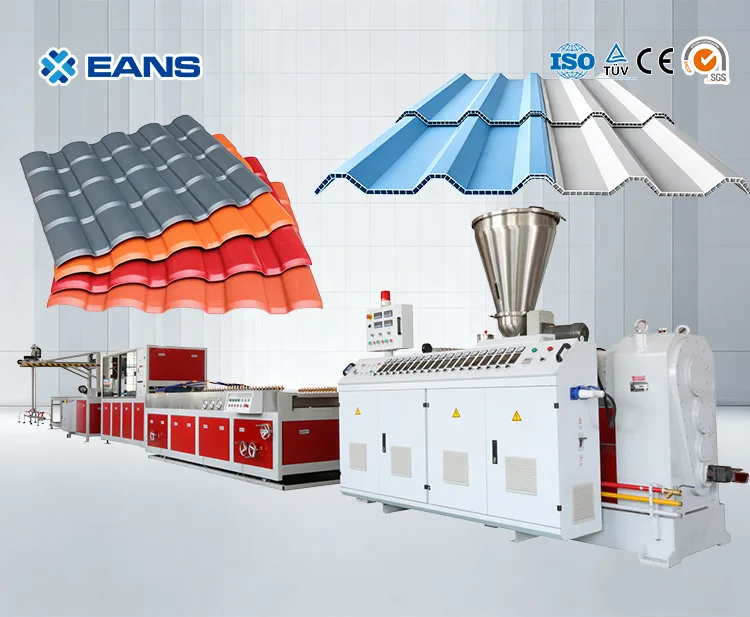
The mixed material enters a conical twin screw extruder for stable plasticization and extrusion.
3. Lamination machine (embossing)
The molten PVC material passes through a specially designed calender machine to form and emboss the wood grain.
4. Vacuum Calibration and Hauling off
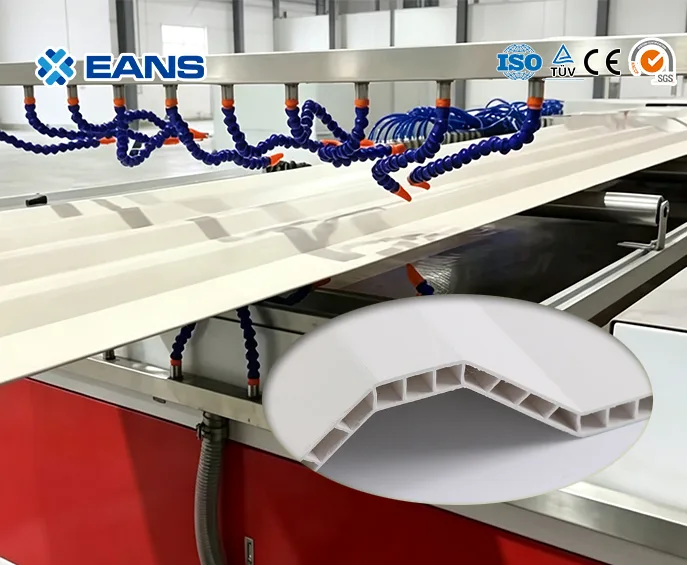
The profile is shaped, cooled, and stabilized through the vacuum calibration system.
5. Punching
Online drilling of installation holes and ventilation
6. Cutting and Stacking
The finished panels are cut into required lengths and prepared for packaging.
A typical PVC wall panel production process includes:
1. Raw Material Mixing
PVC resin, calcium carbonate, stabilizers, fillers, and additives are mixed according to the pvc wall panel formula.
2. Extrusion
The mixed material enters a conical twin screw extruder for stable plasticization and extrusion.
3. Vacuum Calibration and Hauling off
The profile is shaped, cooled, and stabilized through the vacuum calibration system.
4. Online lamination, hot stamping, or printing
Laminate the decorative film on the surface for wood grains, marble, fabric design, etc.
5. Cutting and Stacking
The finished panels are cut into required lengths and prepared for packaging.
Both soffit panels and PVC wall panels have excellent market prospects in the decoration and building materials industry. The final investment decision should be based on the customer’s target market, sales channels, and product positioning.
Choosing the right product direction and extrusion technology is the key to building a successful plastic panel manufacturing business.