PVC Mixer Machine: Why Is Mixing Important Before Extrusion?
29 September, 2026
A PVC marble sheet sample can look acceptable even when the production setup behind it is poorly matched to the buyer’s market. The problems appear later: thickness variation, weak film bonding, uneven gloss, slow specification changes, or a line that cannot make the required width. For technicians and purchasing teams, understanding the finished sheet is only the first step. The more important task is connecting product requirements to the extrusion line, surface treatment system, utilities, and process support.
This guide explains what PVC marble sheet is, how it is made, where it is used, and how to evaluate a PVC marble sheet production line. It also identifies the technical information a machinery supplier needs before proposing an extruder, die, calender, downstream equipment, and auxiliary machines.
PVC marble sheet is a synthetic decorative sheet made with PVC resin, mineral filler, processing additives, pigments, and a printed or laminated surface. The marble appearance comes from decorative film, transfer printing, embossing, and UV coating rather than from natural stone.
The base sheet provides thickness, stiffness, and dimensional stability. The surface system provides the color, veining, gloss, texture, scratch resistance, and resistance to yellowing. This distinction matters in production: an extrusion line can make a flat base sheet, but it cannot by itself create every finished marble effect. Film lamination, printing, UV coating, protective-film application, and other finishing equipment may be required.

| Component | Role in the Sheet |
|---|---|
| PVC resin | Forms the main polymer structure |
| Calcium carbonate | Adds mineral content and changes stiffness, density, processing behavior, and cost |
| Stabilizers and lubricants | Support heat processing and material flow during extrusion |
| Pigments | Control the base color |
| Decorative film or printed layer | Creates the marble, stone, or wood pattern |
| UV coating | Controls gloss and protects the decorative surface |
There is no universal formula for every market. Resin grade, filler quality, filler loading, stabilizer system, sheet thickness, line speed, and the required surface finish all influence the working formula. A supplier should test or adjust the formula against the buyer’s available raw materials instead of treating one recipe as suitable for every plant.
| Decision Factor | PVC Marble Sheet | Natural Marble |
|---|---|---|
| Material | PVC-based decorative composite | Quarried stone |
| Pattern | Controlled by film, printing, and coating | Natural variation between slabs |
| Weight and handling | Lighter and easier to cut with suitable tools | Heavy and requires stone-handling equipment |
| Water exposure | The PVC base does not absorb water, but joints and adhesives still require correct installation | Performance depends on stone type, sealing, and installation |
| Heat and exterior exposure | Requires confirmation of temperature and UV limits | Better suited to high-temperature use when properly selected and installed |
PVC marble sheet is mainly an interior decorative product. It should not be specified as a structural panel, and a buyer should verify fire, weathering, temperature, and chemical-resistance requirements for the target market before production. These properties depend on the formula, coating, test method, and local standard.
Common applications include interior walls, ceilings, door frames, cabinet faces, retail displays, hotel interiors, office fit-outs, and renovation projects. Thin sheets can be used as decorative laminates, while thicker products provide more body for wall and furniture applications.
Application affects machine selection. A plant making 1220 mm interior wall sheets has different die and calender requirements from a plant targeting panels close to 2000 mm wide. A buyer supplying furniture manufacturers may need a wider thickness range and faster pattern changes. Contractors buying finished panels may care more about surface consistency, protective film, cut-length accuracy, and packaging.
The manufacturing route has two connected parts: base-sheet extrusion and surface finishing. The exact sequence changes with the selected film, embossing method, UV coating process, and final product specification.

PVC resin, calcium carbonate, stabilizers, lubricants, pigments, and other approved additives are weighed and mixed. The hot-mixing stage disperses the ingredients and raises the compound to the required process temperature. Cooling prevents agglomeration and prepares the dry blend for storage or feeding.
A high-speed PVC heating and cooling mixer should be sized to the extruder output and batch cycle. Mixer capacity that is too low interrupts extrusion; excessive capacity can add cost and floor-space requirements without improving output.
The dry blend enters a conical twin-screw extruder. The screws convey, heat, compress, mix, and plasticize the PVC compound. Barrel temperature, screw speed, feed rate, vacuum performance, and extrusion pressure must work together. Excess heat can degrade PVC, while incomplete plasticization may cause poor surface quality or unstable mechanical properties.
The plasticized material leaves the extruder through a T-die. The die distributes the melt across the required sheet width. Die design and adjustment affect transverse thickness uniformity, edge stability, and material flow. Buyers changing sheet width or thickness should confirm whether the proposed die and downstream system cover the complete product range.
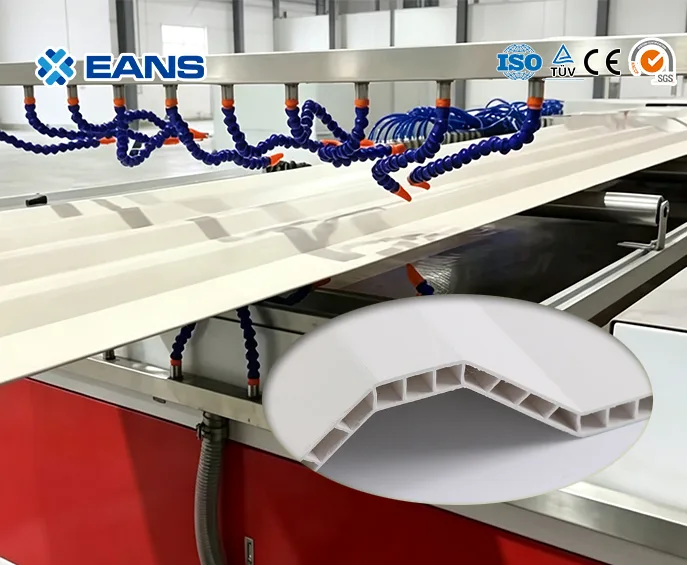
The hot sheet passes through the calender. Roller gap, roller temperature, synchronization, and pressure control the sheet thickness, flatness, and surface. Decorative film can be laminated online, and embossing can be integrated when the required finish and process permit it.
EANS uses a four-roll calender system on its current marble-sheet line. The supplier states that independent servo synchronization and roller temperature control can hold surface flatness error below 0.1 mm under the specified setup. Buyers should confirm the inspection method and acceptance conditions during technical negotiations.
The formed sheet is cooled while its shape is controlled. The haul-off must match extrusion and calender speed to avoid stretching or compression. Edge trimming removes unstable sides, the cross cutter controls final length, and the stacker receives the finished sheets. Protective film and packaging equipment can be added according to the surface and shipping method.
UV coating is a separate finishing stage in many plant layouts. It changes gloss, surface feel, wear behavior, and protection of the printed layer. A production proposal should state whether the UV line is included, optional, or supplied separately. It should also identify the compatible coating, curing arrangement, line speed, ventilation, and handling requirements.
A complete PVC marble sheet production line normally includes the main extrusion line plus raw-material and finishing equipment. The purchase scope should list each machine rather than using the phrase “complete line” without boundaries.

The quotation should also identify utilities and buyer-supplied items. Chillers, cooling towers, air compressors, electrical cables, water piping, lifting tools, laboratory equipment, spare parts, and installation materials are not always included in the main line price.
EANS lists two standard configurations for different sheet widths, thickness ranges, and output targets. These figures are equipment specifications, not a guarantee that every formula and sheet thickness will run at the maximum stated output.
| Parameter | SJZ80/156 | SJZ92/188 |
|---|---|---|
| Applicable material | PVC | PVC |
| Applicable panel width | Below 1220 mm | Below 2000 mm |
| Sheet thickness | 0.5–4 mm | 1.5–6 mm |
| Main motor | 75 kW | 110 kW |
| Nominal capacity per 24 hours | 10 tons | 12–15 tons |
| Listed line dimensions | 22 × 4 × 3.5 m | 24 × 4 × 3.5 m |
The SJZ80/156 is the direct choice when the saleable range stays below 1220 mm and includes sheets thinner than 1.5 mm. The SJZ92/188 is required when the product plan includes widths above 1220 mm or the higher listed output range. Do not select the larger extruder only from its tonnage figure; verify the die width, calender width, product thickness, formula, surface process, cooling capacity, and downstream speed as one system.
Send the supplier a drawing or specification sheet with panel width, thickness, length, acceptable dimensional tolerance, surface pattern, gloss level, embossing, protective film, packaging, and applicable test requirements. A sample alone may not communicate tolerance or inspection criteria.
Machine output is commonly stated in kilograms or tons, while finished sheets are sold by piece or square meter. Convert the required sales volume into mass using the intended density, thickness, width, and length. Ask for estimated output at the main products rather than accepting one maximum figure for the whole thickness range.
Provide the planned PVC resin grade, calcium carbonate specification, additives, decorative film, and UV coating information. If local materials will be used, arrange a material test or formula review. High filler loading changes plasticization, screw load, die pressure, sheet brittleness, and surface behavior.
State whether the plant must deliver an extruded base sheet, an online-laminated sheet, or a finished UV-coated panel. Confirm which patterns can change through film replacement and which changes require a different die, roller, coating, or formula.
Line dimensions are not the same as the required building size. The layout must include raw-material storage, mixing, feeding, extrusion, UV coating, finished-goods handling, maintenance clearance, electrical cabinets, water circulation, compressed air, ventilation, and safe movement around the equipment.
The technical agreement should state the test material, sheet specification, trial duration, output measurement, tolerance, surface inspection, power conditions, included tooling, documentation, spare parts, and training scope. Video inspection can support a review, but it does not replace measurable acceptance criteria.
| Problem | Items to Check |
|---|---|
| Thickness variation across the width | Die-lip setting, melt distribution, calender gap, roller alignment, and temperature uniformity |
| Sheet warping | Uneven cooling, roller temperature, haul-off synchronization, residual stress, and stacking temperature |
| Rough surface or poor gloss | Material dispersion, plasticization, moisture, die condition, roller surface, film, and coating parameters |
| Film lifting or weak bonding | Surface temperature, lamination pressure, line speed, film compatibility, and contamination |
| Yellowing or discoloration | PVC heat history, stabilizer system, cooling, UV coating, curing settings, and exposure conditions |
| Unstable output | Feeding consistency, dry-blend quality, screw wear, vacuum system, temperature control, and downstream speed |
Operators should change one controlled parameter at a time and record the result. Adjusting temperature, screw speed, haul-off speed, and calender gap together makes it difficult to identify the actual cause.
EANS configures the extrusion system around the buyer’s target panel width, thickness, output, raw material, and surface requirements. Its PVC artificial marble sheet production solution covers mixing, feeding, conical twin-screw extrusion, T-die forming, calendering, cooling, haul-off, cutting, and stacking. UV and other finishing requirements should be confirmed in the final scope.
Before delivery, the project should define the workshop layout, installation and running power, water demand, compressed air, tooling, formula support, and acceptance product. EANS also provides installation, commissioning, technical support, and operator training. The service boundary, travel conditions, buyer responsibilities, and response arrangements should be written into the quotation or contract.
No. It is a PVC-based decorative sheet. Calcium carbonate may be used as a mineral filler, but the marble pattern comes from decorative film, printing, embossing, or coating.
The main equipment includes a heating and cooling mixer, feeder, conical twin-screw extruder, T-die, calender, cooling frame, haul-off, cutter, and stacker. Film lamination, UV coating, protective-film, and packaging equipment depend on the required finished product.
It is suited to PVC dry-blend processing and provides the conveying, mixing, plasticization, and pressure needed for a highly filled sheet formula. Screw design and drive size must match the material and output.
It may be quoted as a connected or separate finishing line. Buyers should confirm the coating, curing, ventilation, protective-film, and handling equipment rather than assuming they are included in the base extrusion price.
Yes, many pattern changes can be made by changing the decorative film or printing setup. Different sheet widths, thicknesses, embossing patterns, gloss levels, or material properties may also require changes to the die, roller, coating, formula, and process settings.
Compare output using the same raw material, sheet width, thickness, density, surface process, and trial conditions. Maximum extruder output alone does not show how many finished square meters or acceptable sheets the plant can produce.
Provide the available length, width, clear height, floor loading, incoming power, water system, compressed air, ventilation, raw-material route, finished-product route, and local safety requirements. Include maintenance and lifting clearance around the line.
Test the agreed product with the agreed material where possible. Record stable output, sheet dimensions, thickness variation, flatness, surface appearance, cutting accuracy, line speed, alarm functions, and the operation of included auxiliary equipment.
Prepare the finished-sheet drawing, width and thickness range, target output, raw-material details, surface treatment, pattern-change requirements, utilities, workshop dimensions, local electrical standard, delivery destination, and required commissioning support.
A useful proposal should connect the finished sheet to every major machine, utility, and acceptance item. Send EANS your product drawing, width, thickness range, daily output, PVC and filler information, decorative process, workshop dimensions, power standard, destination, and expected delivery schedule. You can then request a PVC marble sheet production line proposal with the equipment list, layout, utility requirements, tooling, service scope, and technical points that still require confirmation.