WPC Door Making Machine
Home Product PVC WPC Door Making Machine WPC Door Making Machine
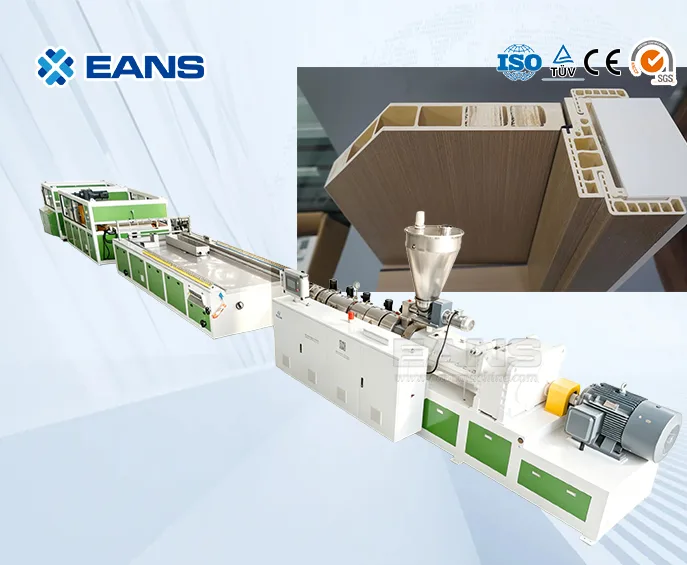
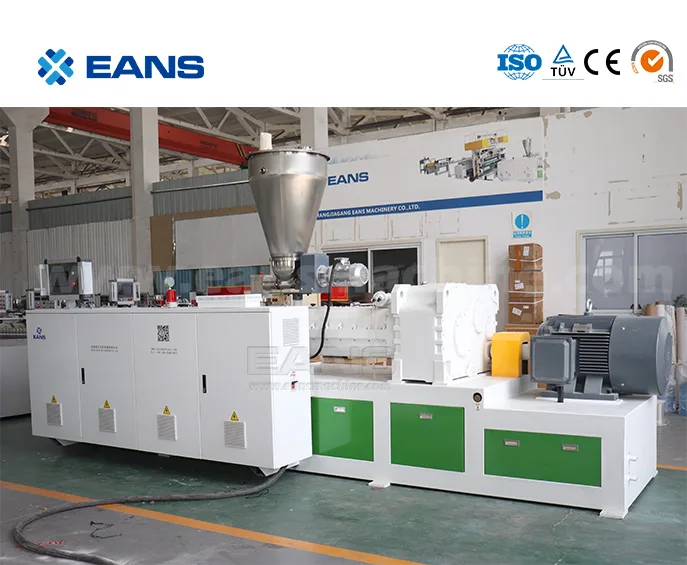
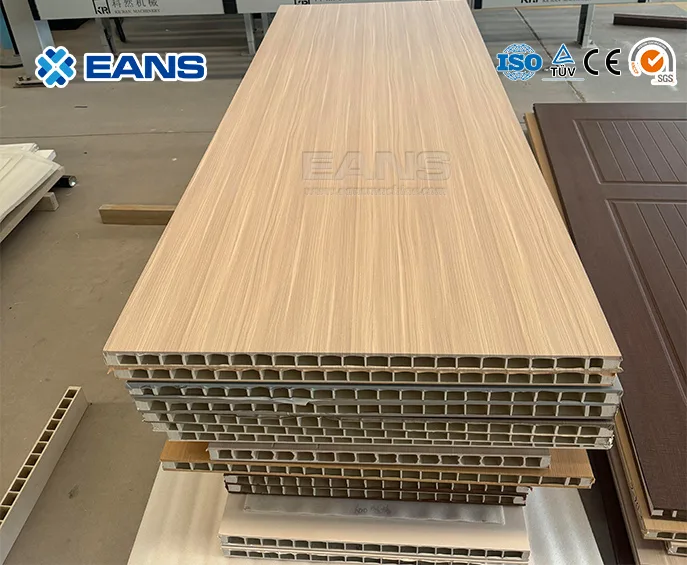
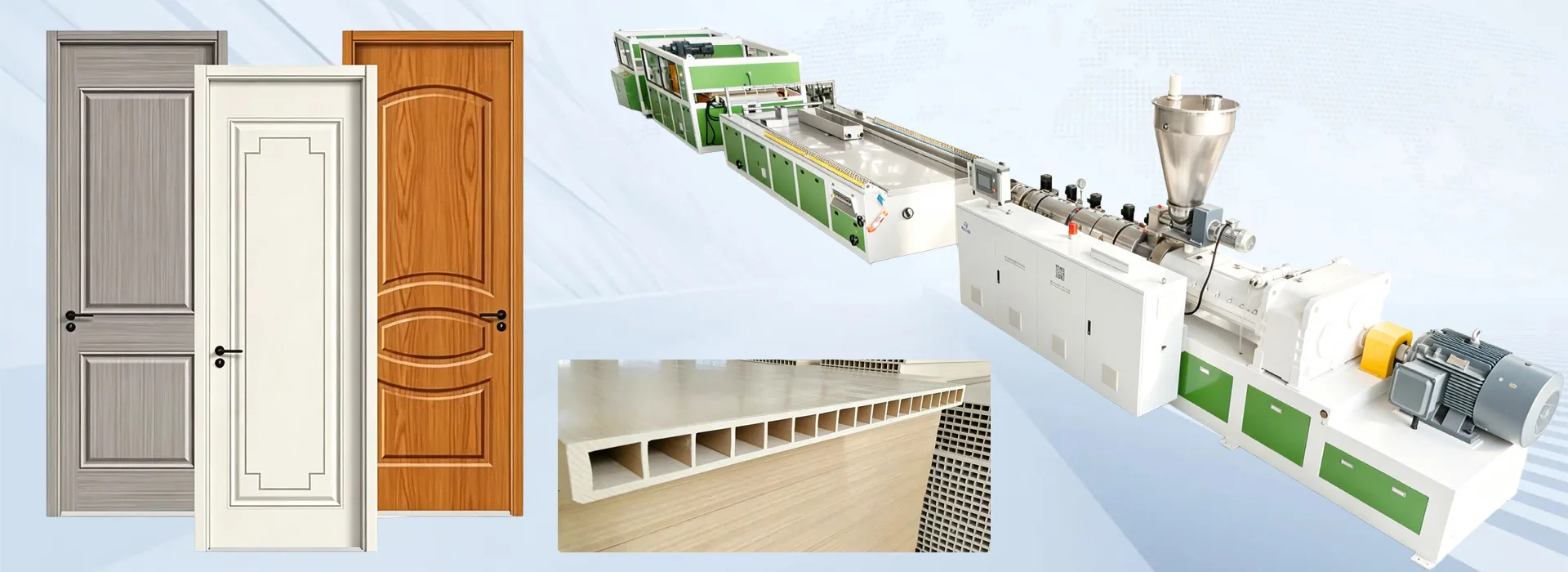
A WPC door making machine is an extrusion production line designed to manufacture waterproof WPC door panels from wood-plastic composite materials. It melts, mixes, and continuously extrudes the WPC material through a customized door panel die, followed by calibration, cooling, haul-off, and cutting to produce door panels with consistent dimensions and surface profiles.
Door Panel Width: 600mm, 800mm, 1000mm, 1150mm, 1200 mm, etc. customized widths available according to market requirements.
Required materails for WPC door production: PVC resin, calcium carbonate, wood flour, and additives.
As a professionale wpc door making machine manufacturer, EANS provides extrusion equipment and customized molds to factory trial runs, overseas installation, and after-sales technical support. EANS helps you build a production line around your required panel width, thickness, design, and output.
The EANS WPC door making machine is designed for the continuous extrusion of waterproof WPC door panels. Different models are available to match various panel widths and production capacity requirements.
| Model | SJ65/132 | SJ80/156 | SJ92/188 |
|---|---|---|---|
| Extruder Type | Conical Twin-Screw Extruder | ||
| Production Capacity | 250 KG/H | 450KG/H | 650KG/H |
| Panel Width | 300 - 600 MM | 600-800 MM | 800 -1200 MM |
| Panel Thickness | 5 - 5o MM, customized | ||
| Speed | 2.5 M/MIN | 2M/MIN | 1.5 M/MIN |
| Calibration TableLength | 6M | ||
| Cutting Method | Automatic Tracking Saw Cutting | ||
| Drive & Control | ABB Inverter; Simens components avaliable | ||
| Installed Power | 95KW | 185KW | 250 KW |
| Item | Specification |
|---|---|
| Product | WPC Door Panel |
| Raw Material | PVC + Wood Powder + Calcium Carbonate + Additives |
| Extruder Type | Conical Twin Screw Extruder |
| Cutting Method | Automatic Length Cutting |
| Control System | Siemens PLC (Optional) |
| Inverter | ABB (Optional) |
| Temperature Control | Omron (Optional) |
| Power Supply | Customized (380V/50Hz, 415V/50Hz, etc.) |
The quality of WPC door panels is mainly determined by four factors: raw material preparation, extrusion temperature control, die pressure and cooling, and post-extrusion conditioning. These factors directly affect panel density, surface finish, strength, flatness, and dimensional stability.
1. Raw Material Moisture & Formulation
Wood flour moisture and material formulation directly affect the foam structure and extrusion stability. Excessive moisture can cause internal voids and surface blisters, while an improper balance of PVC, wood flour, stabilizers, lubricants, and foaming agents can affect melt strength and surface quality.
EANS Solution: The extrusion process is adjusted according to the actual WPC formulation and raw material condition to maintain stable plasticization and material flow.
2. Extrusion Temperature & Foaming Control
The extrusion temperature profile affects plasticization, melt viscosity, and foam-cell formation. Excessive temperature can destabilize the foam structure, while insufficient heat can result in incomplete plasticization and higher panel density.
EANS Solution: Multi-zone temperature control allows the processing conditions to be adjusted according to the WPC formulation, panel density, and production requirements.
3. Die Pressure, Calibration & Cooling
For Celuka WPC door panel extrusion, stable melt pressure and uniform calibration are essential for forming the dense outer skin and foamed core. Uneven vacuum or cooling can cause thickness variation, deformation, or panel warping.
EANS Solution: The extrusion die, vacuum calibration, cooling, and production speed are coordinated according to the panel width and thickness to maintain consistent forming and dimensional stability.
4. Post-Extrusion Conditioning
Freshly extruded WPC door panels may retain internal thermal stress. Sufficient cooling and flat stacking before cutting, CNC processing, or lamination help reduce dimensional changes and warping during subsequent processing.
EANS Solution: The downstream process is arranged according to the panel thickness and application, allowing the panels to stabilize before secondary processing or surface finishing.
In short, consistent WPC door panel quality depends on controlling the material, extrusion, forming, and conditioning stages as one continuous process.
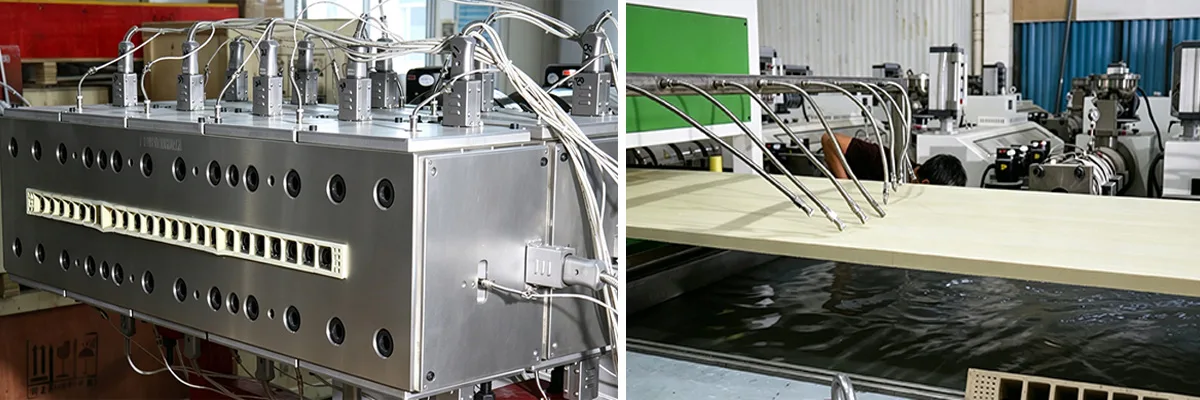
The WPC door making machine is designed for continuous extrusion of thick, wide WPC door panels with a foamed core and dense outer skin. Its extrusion, forming, haul-off, cutting, and control systems are configured to maintain stable material processing and consistent panel dimensions.
1. Heavy-Duty Conical Twin-Screw Extrusion
WPC door compounds containing wood flour and mineral fillers require stable feeding, mixing, plasticization, and extrusion pressure. The conical twin-screw extruder provides high material conveying and mixing performance while processing heat-sensitive PVC-based WPC compounds.
The extrusion system can be configured with multi-zone temperature control and vacuum degassing to help remove moisture and volatile components from the melt, reducing the risk of internal voids and surface defects.
Key benefits: Stable plasticization, consistent material flow, and reliable extrusion of thick WPC door panels.
2. Wide-Panel Extrusion Die & Calibration
The WPC door panel extrusion die is designed for the required panel width, thickness, and structure. Balanced melt distribution across the die helps maintain consistent panel thickness and surface quality.
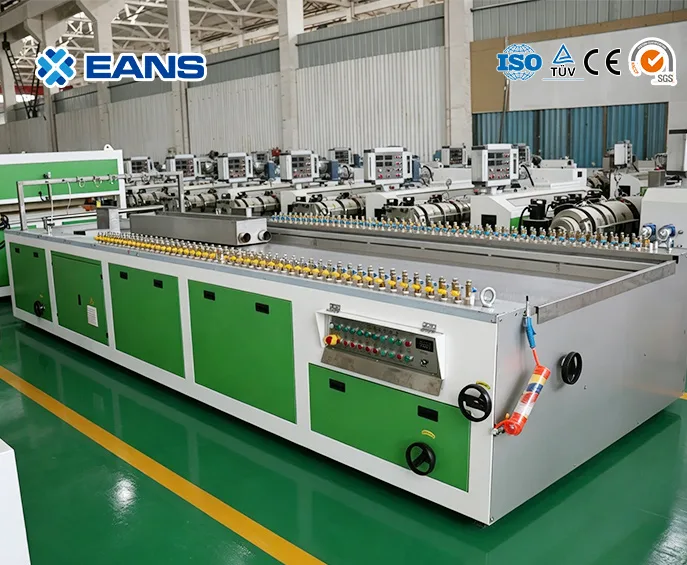
The vacuum calibration and cooling system stabilizes the hot panel after extrusion, helping form a flat, dimensionally consistent outer surface while the foamed core develops inside the panel.
Key benefits: Uniform panel thickness, stable dimensions, smooth surface, and reduced risk of deformation.
3. Synchronized Haul-Off & Automatic Cutting
Wide and thick WPC door panels require stable pulling force throughout the production process. The haul-off system works in coordination with the extrusion output to maintain consistent panel movement and dimensions.
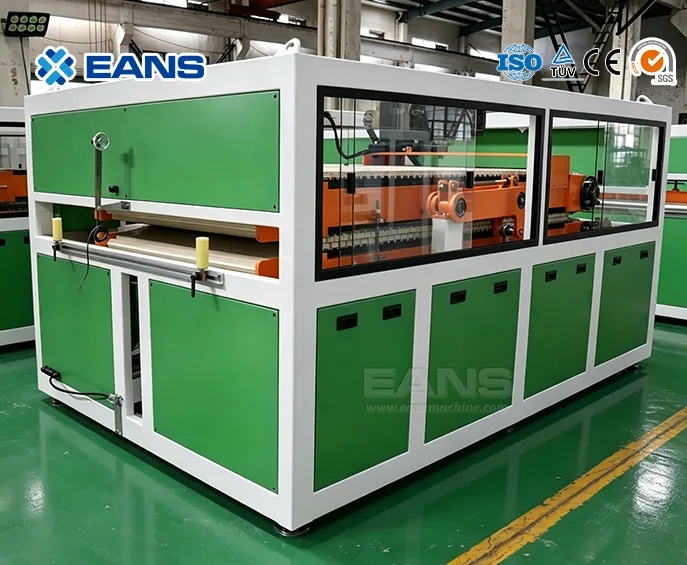
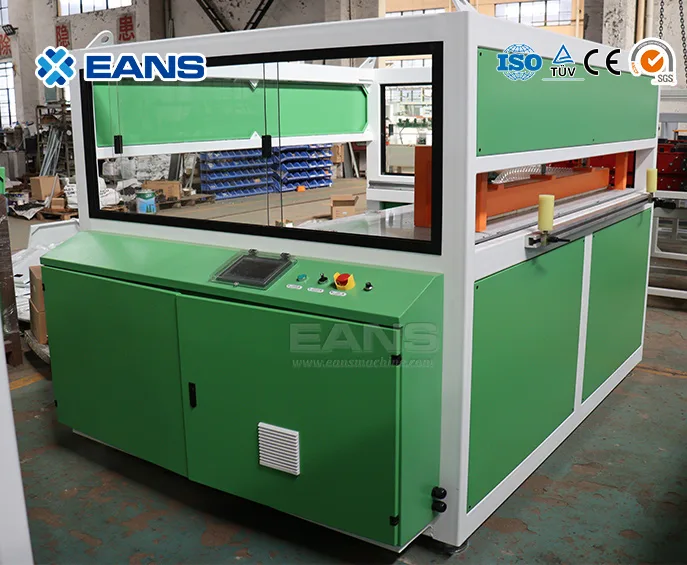
The automatic cutting system cuts the continuously extruded panel to the required length with consistent positioning and square ends.
Key benefits: Stable panel dimensions, consistent production speed, and accurate finished lengths.
4. Integrated PLC Control System
The WPC door panel production line integrates extrusion, feeding, temperature control, haul-off, and cutting into one coordinated control system. PLC-based control allows key operating parameters to be monitored and adjusted during continuous production.
This helps operators maintain consistent processing conditions when producing different WPC door panel widths, thicknesses, and formulations.
Key benefits: Coordinated line operation, easier parameter adjustment, and more consistent production.
5. Production Configuration for Different Panel Sizes
The WPC door panel machine can be configured for different panel widths and production capacities. EANS offers models for 600 mm, 800 mm, and 1200 mm WPC door panels, with customized configurations available for specific product requirements.
Key benefits: A production system matched to the required panel size, output, and product structure.
| Equipment | Quantity |
|---|---|
| Automatic Feeder | 1 Set |
| Conical Twin Screw Extruder | 1 Set |
| WPC Door Panel Extrusion Mold | 1 Set |
| Vacuum Calibration Table | 1 Set |
| Cooling System | 1 Set |
| Haul-off Machine | 1 Set |
| Automatic Cutting Machine | 1 Set |
| Product Stacking Table | 1 Set |
The WPC door making machine configuration can be adjusted according to your specific production requirements. The required equipment, machine specifications, mold design, and optional configurations will be customized based on door panel size, production capacity, raw materials, and factory conditions.
The WPC door panel manufacturing process is a continuous extrusion process that converts PVC resin, wood powder, fillers, and additives into finished WPC door panels.
Production Flow:
Raw Material Preparation – Dry and prepare wood powder, PVC resin, fillers, and additives.
Hot & Cold Mixing – Mix the materials uniformly and cool the dry blend for stable extrusion.
Twin-Screw Extrusion – Feed the mixture into a conical twin-screw extruder for plasticizing and foaming.
Die Forming & Vacuum Calibration – Shape the melt through a WPC door panel extrusion die and calibrate the panel through the Celuka vacuum system.
Cooling & Haul-Off – Cool the formed panel and continuously pull it through the haul-off unit.
Cutting & Stacking – Cut the continuous WPC door panel to the required length and stack the finished panels.
Surface Finishing – Optional sanding, lamination, hot stamping, CNC routing, or other finishing processes can be added according to the final panel design.
We value your privacy
We use cookies to enhance your browsing experience, serve personalised ads or content, and analyse our traffic. By clicking "Accept All", you consent to our use of cookies.
Customise Consent Preferences
We use cookies to help you navigate efficiently and perform certain functions. You will find detailed information about all cookies under each consent category below.
The cookies that are categorised as "Necessary" are stored on your browser as they are essential for enabling the basic functionalities of the site. Show more
Necessary cookies are required to enable the basic features of this site, such as providing secure log-in or adjusting your consent preferences. These cookies do not store any personally identifiable data.
Functional cookies help perform certain functionalities like sharing the content of the website on social media platforms, collecting feedback, and other third-party features.
Analytical cookies are used to understand how visitors interact with the website. These cookies help provide information on metrics such as the number of visitors, bounce rate, traffic source, etc.
Performance cookies are used to understand and analyse the key performance indexes of the website which helps in delivering a better user experience for the visitors.
Advertisement cookies are used to provide visitors with customised advertisements based on the pages you visited previously and to analyse the effectiveness of the ad campaigns.