WPC Door Making Machine Passes Factory Trial for Saudi Arabian Project
22 October, 2026
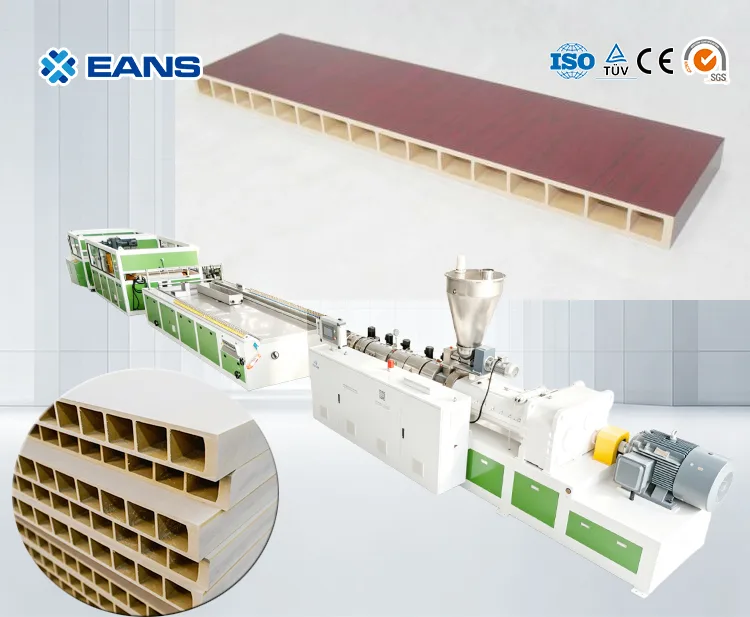
EANS has completed factory testing of three customized WPC door frame production lines for a project in Saudi Arabia. Each line was configured for the customer’s specified profiles, with equipment and tooling matched to the intended products.
The factory trial involved running the equipment and producing door frame profiles before shipment. The video and photographs below show the equipment and trial products.
Video: Factory testing of EANS WPC door frame making machine. The footage shows the actual equipment and production process before delivery.
The Saudi Arabian project required three WPC door frame production lines for different product specifications. Although the exact dimensions are confidential, each line was configured according to the customer’s individual requirements.
For WPC door frame manufacturers, different profile dimensions and cross-sectional designs can affect mold construction, material flow, calibration arrangements and cooling requirements. These factors need to be considered together when configuring a complete WPC door frame making machine.
EANS approached the project by considering the intended profile for each line and matching the relevant equipment configuration to the customer’s requirements. This is particularly important when several production lines are purchased for different products: the goal is not simply to supply multiple machines, but to prepare each line for its designated profile and production task.
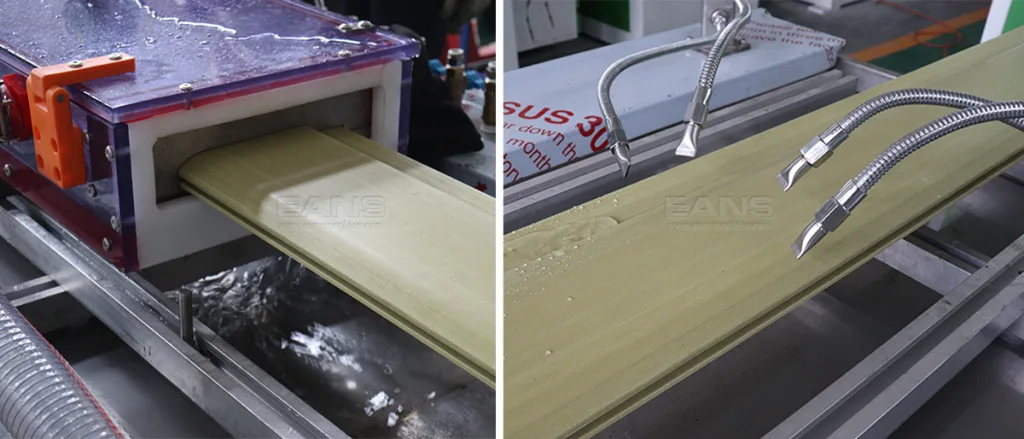
Caption: Factory testing of EANS customized WPC door frame making machine for the Saudi Arabian project.
The factory trial also provided an opportunity to observe equipment operation and review the produced profiles under the test conditions. Any final statements about dimensional accuracy, production capacity or acceptance should be based on the actual test records and agreed project requirements.
A WPC door frame making machine is a complete extrusion line, The extrusion system, die, calibration and cooling equipment, haul-off and cutter are selected together according to the target profile. For this project, the three lines required configurations suited to different door frame specifications.
For a customized project, the main engineering consideration is how these components work together to produce the intended profile. Selecting individual machines without considering the complete process may result in a configuration that does not fully match the target product.
The extruder processes the WPC compound and delivers the material to the forming die. The appropriate configuration depends on the material formulation, profile structure and required production output.
During production line planning, the extrusion system needs to be considered alongside the target profile and the requirements of the downstream equipment. Stable material delivery provides the foundation for subsequent forming, calibration and cooling.
The mold determines the cross-sectional shape of the extruded WPC door frame. Its design must correspond to the required profile geometry and provide a suitable flow path for the material.
Because the three lines serve different product specifications, mold matching is a central part of this project’s customization. The mold design and calibration arrangement need to be considered together so that the profile can be formed and supported appropriately after leaving the die.
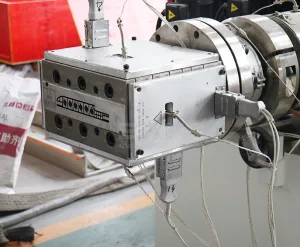
Caption: Mold and forming equipment used for WPC door frame extrusion.
After leaving the die, the extruded profile enters the calibration and cooling section. This stage helps establish the intended cross-sectional shape and maintain the profile dimensions as the material cools.
The calibration system must suit the profile geometry, while the cooling arrangement must support the material’s transition from the hot extrudate to a sufficiently stable profile for subsequent handling.
For buyers comparing WPC door frame making machines, this section deserves particular attention. A suitable mold alone does not guarantee a finished profile that meets requirements; the calibration and cooling process must also be compatible with the product design and extrusion conditions.
The haul-off unit pulls the profile through the production line at a controlled speed. The cutting unit then cuts the profile to the required length according to the production setup.
The haul-off speed needs to be coordinated with extrusion and calibration. An unsuitable pulling speed can affect profile dimensions and surface quality, particularly when the material has not cooled sufficiently.
These components therefore need to operate as a coordinated system rather than as isolated machines.
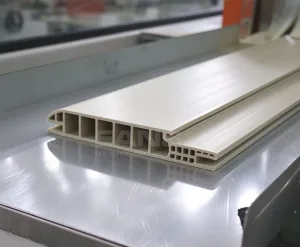
The finished profiles provide direct evidence of the product produced during the factory trial. Together with the equipment and running footage, these images help buyers understand the relationship between the production line and its intended output.
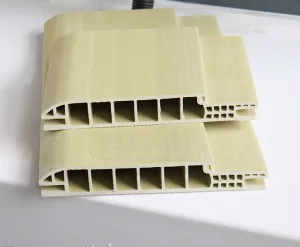
Caption: WPC door frame profiles produced during factory testing.
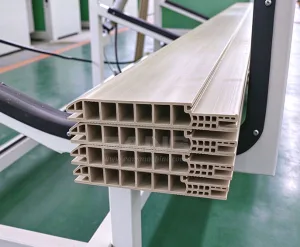
Caption: Close-up view of the WPC door frame profile produced during the trial.
When reviewing a WPC door frame making machine, buyers should assess the actual profile against the agreed product drawings and acceptance criteria. Relevant checks may include cross-sectional dimensions, shape, surface appearance and consistency between samples. Where inspection records are available, these can be used to document the results of the factory trial.
Where dimensional inspection records are available, profile measurements can be compared with the agreed drawings and tolerances. Other checks can include cross-sectional shape, surface appearance and the consistency of the produced profiles under the trial conditions.
These checks should be based on the actual acceptance requirements agreed for the project. Factory testing provides an opportunity to review these factors before the equipment is shipped to the customer’s facility.
Factory testing is an important stage between equipment manufacturing and delivery. It provides an opportunity to operate the production line, review the trial process and identify any adjustments needed before the equipment leaves the factory.
For a customized WPC door frame production line, testing can help buyers and the manufacturer review the equipment against the agreed project requirements.
The main considerations may include:
For buyers, the value of factory testing depends on what is actually checked and documented. Reviewing the trial profiles, inspection results and agreed acceptance criteria provides a clearer basis for evaluating the equipment before shipment than relying on equipment specifications alone.
The Saudi Arabian project highlights an important consideration in WPC door frame manufacturing: different product specifications may require different mold and equipment configurations.
EANS configures WPC door frame production lines according to the customer’s profile drawings, dimensions, material formulation and target output. These inputs guide the selection of the extrusion system, tooling, calibration, cooling and downstream equipment.
Project support includes factory trials, overseas installation and commissioning, and after-sales technical assistance. The equipment scope, testing arrangements and service requirements should be confirmed for each project.
EANS provides factory trial runs, overseas installation and commissioning, and after-sales technical support to help customers prepare their production lines for operation.
For manufacturers planning to produce several WPC door frame specifications, discussing each target profile with the equipment supplier before ordering can help clarify mold requirements, machine configuration, inspection criteria and the scope of the complete production line.
If you are planning to manufacture WPC door frames, the appropriate production line depends on your target profile, material formulation and production requirements.
To evaluate a suitable WPC door frame making machine, send EANS the following product and production information to discuss the equipment configuration and tooling requirements:
Even if the final dimensions are not yet fixed, an initial profile drawing or sample can help EANS understand the product structure and assess the preliminary equipment and mold requirements.
Contact EANS to discuss your WPC door frame project and obtain a production line solution tailored to your manufacturing requirements.