Home Product PVC WPC Door Making Machine PVC Door Panel Extrusion Line
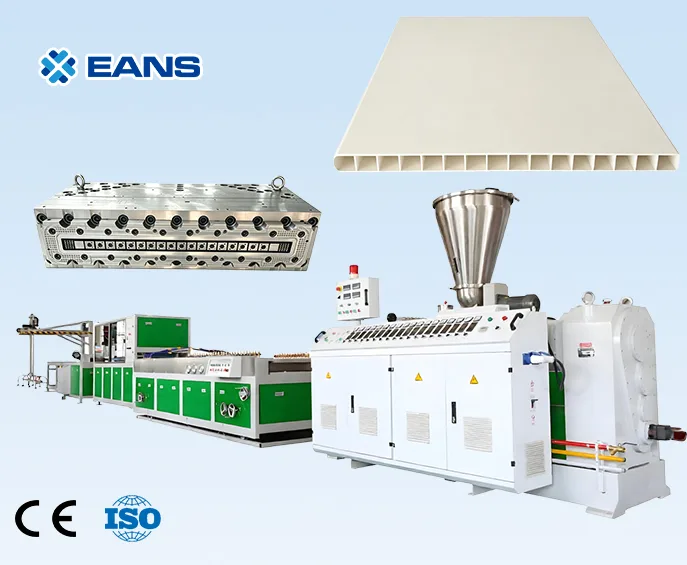
EANS PVC door panel extrusion line is designed for the continuous production of rigid PVC door panels in different widths, with 600 mm being a common configuration. The line can produce PVC door panels with customized widths, thicknesses, surface designs, and production capacities. A complete PVC door panel making machine typically includes a conical twin-screw extruder, customized extrusion die, vacuum calibration and cooling table, haul-off, automatic cutting machine, and stacking system..
EANS provides complete PVC door extrusion line solutions that combine flexible production, cost control, and reliable technical support.
| Extruder Model | SJZ65/132 | SJZ80/156 | SJZ92/188 |
|---|---|---|---|
| Extruder Type | Conical Twin-Screw Extruder | ||
| Production Capacity | 250 kg/h | 450 kg/h | 650 kg/h |
| Panel Width | 300 mm - 600mm | 600 mm - 800 mm | 800 mm - 1200 mm |
| Panel Thickness | 5 - 50 mm, customized | ||
| Speed | 2.5 m/min | 2 m/min | 1.5 m/min |
| Calibration Table Length | 6 m | 6 m | 8 m |
| Cutting Method | Automatic Tracking Saw Cutting | ||
| Drive & Control | ABB Inverter; Siemens components available | ||
| Installed Power | 95 KW | 185 KW | 250 KW |
EANS PVC door panel extrusion line is designed for efficient production of customizable PVC door panels, with common configuration. EANS offers flexible production line configurations to meet different requirements for door panel width, thickness, surface design, and production capacity. For manufacturers requiring wider panels or higher output, larger extrusion systems can also be configured
PVC Door Production Process
Raw Material Feeding → Extrusion → Die Forming → Calibration & Cooling → Haul-Off → Cutting → Stacking
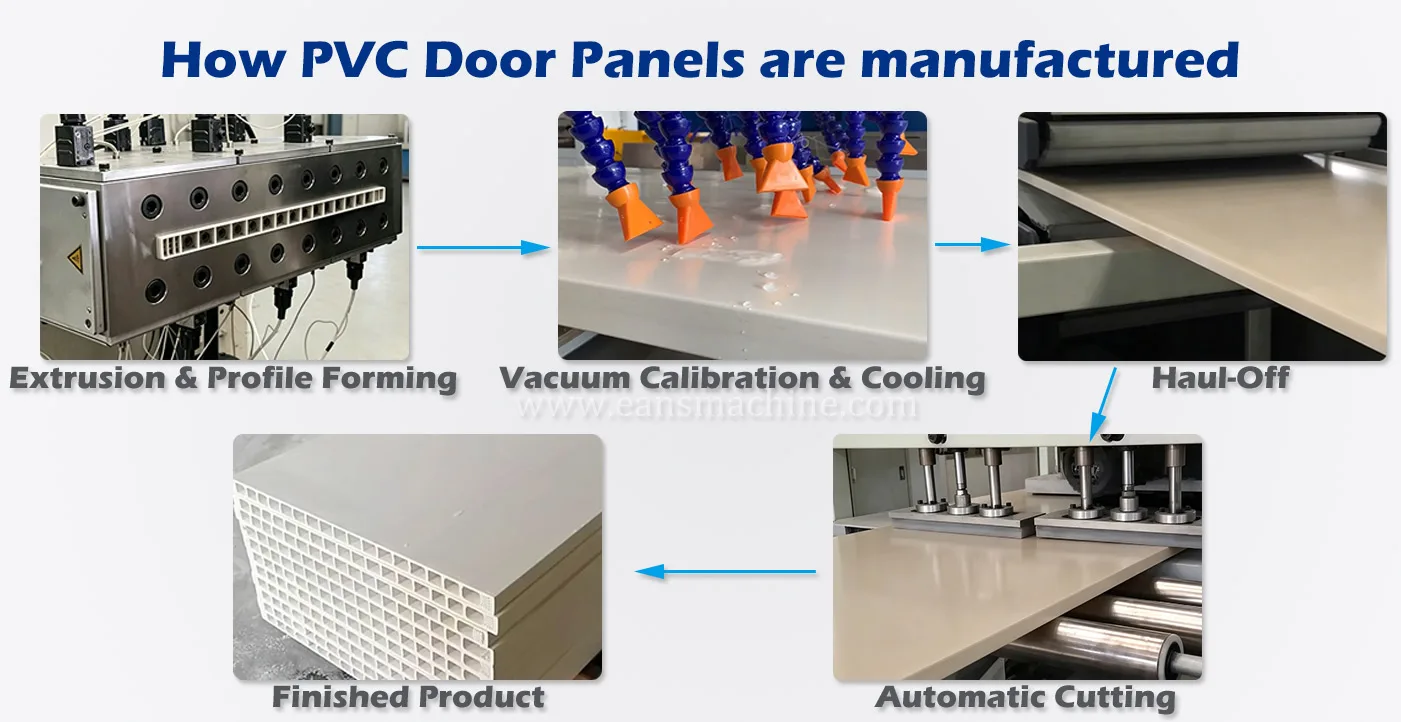
A PVC door making machine is an extrusion production line designed to manufacture rigid PVC door panels, door boards, and related PVC profiles. The line continuously extrudes a PVC compound through a specially designed die, then calibrates, cools, pulls, cuts, and optionally laminates the finished product.
PVC mixing system – mixes PVC resin, calcium carbonate, stabilizers, lubricants, pigments, and other additives.
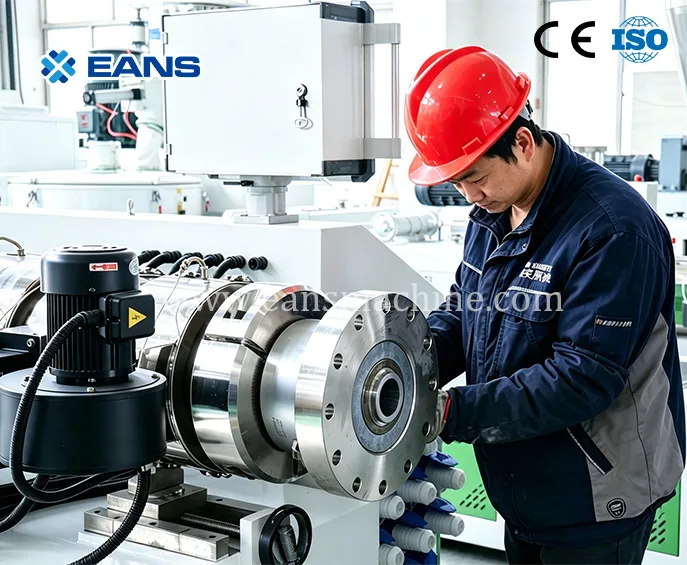
Conical twin screw extruder – plasticizes and homogenizes the PVC compound.
PVC door panel extrusion die – determines the panel width, thickness, and cross-sectional structure.
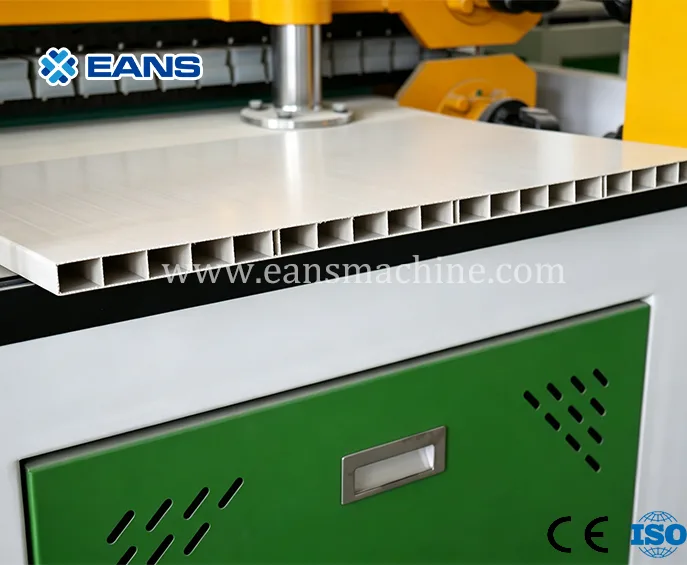
Vacuum calibration table – controls the dimensions and surface quality.
Haul-off machine – continuously pulls the extruded PVC panel.
Cutting machine – cuts the panel to the required length.
Stacking unit – automatically collects finished panels when required.
Lamination/printing equipment – optional equipment for decorative surfaces, such as wood-grain or marble effects.
Main Equipment of PVC Door Panel Extrusion Line
| Equipment | Qty | Main Function |
|---|---|---|
| Heating cooling mixer | 1 set | Mixing PVC resin, additives, and other raw materials |
| Automatic Feeder | 1 set | Feeding the mixed material into the extruder |
| PVC Extruder | 1 set | Plasticizing and continuously extruding PVC material |
| Extrusion Die | 1 set | Forming the required PVC door panel shape and dimensions |
| Vacuum Calibration & Cooling Unit | 1 set | Calibrating panel dimensions and cooling the extruded panel |
| Haul-Off Machine | 1 set | Pulling the panel at a stable and controlled speed |
| Cutting Machine | 1 set | Cutting panels to the required length |
| Stacking Table | 1 set | Collecting and stacking finished PVC door panels |
1. Match the Extruder Size to Your Target Output
Different extruder models provide different processing capacities for PVC door panel production. SJZ65/132, SJZ80/156, and SJZ92/188 can be configured for different panel sizes and production requirements, ranging from standard-width panels to wider, higher-output applications.
2. Match the Screw and Die to the PVC Formulation
The screw and die should be selected based on the PVC formulation, filler content, panel thickness and width, and production speed. A properly matched PVC door panel extrusion line helps achieve stable plasticization, uniform material distribution, and consistent panel dimensions.
3. Match the Calibration and Haul-Off System to Panel Size
Wide or thick PVC door panels require sufficient calibration length and stable haul-off performance. The calibration table and multi-track haul-off system should provide consistent cooling, pulling force, and dimensional control to help maintain panel flatness and accuracy during continuous production.
4. Consider the Finished PVC Door Panel Requirements
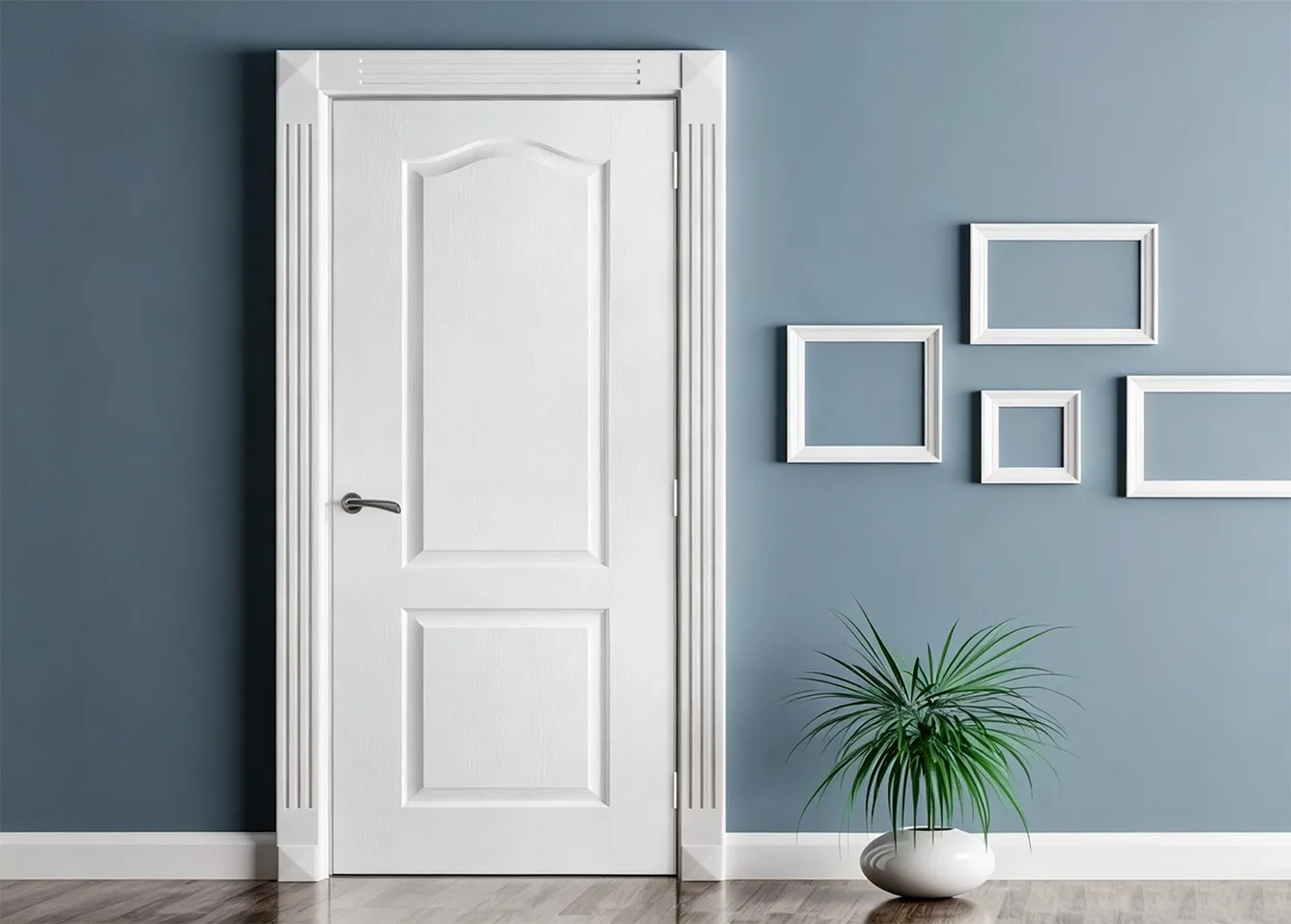
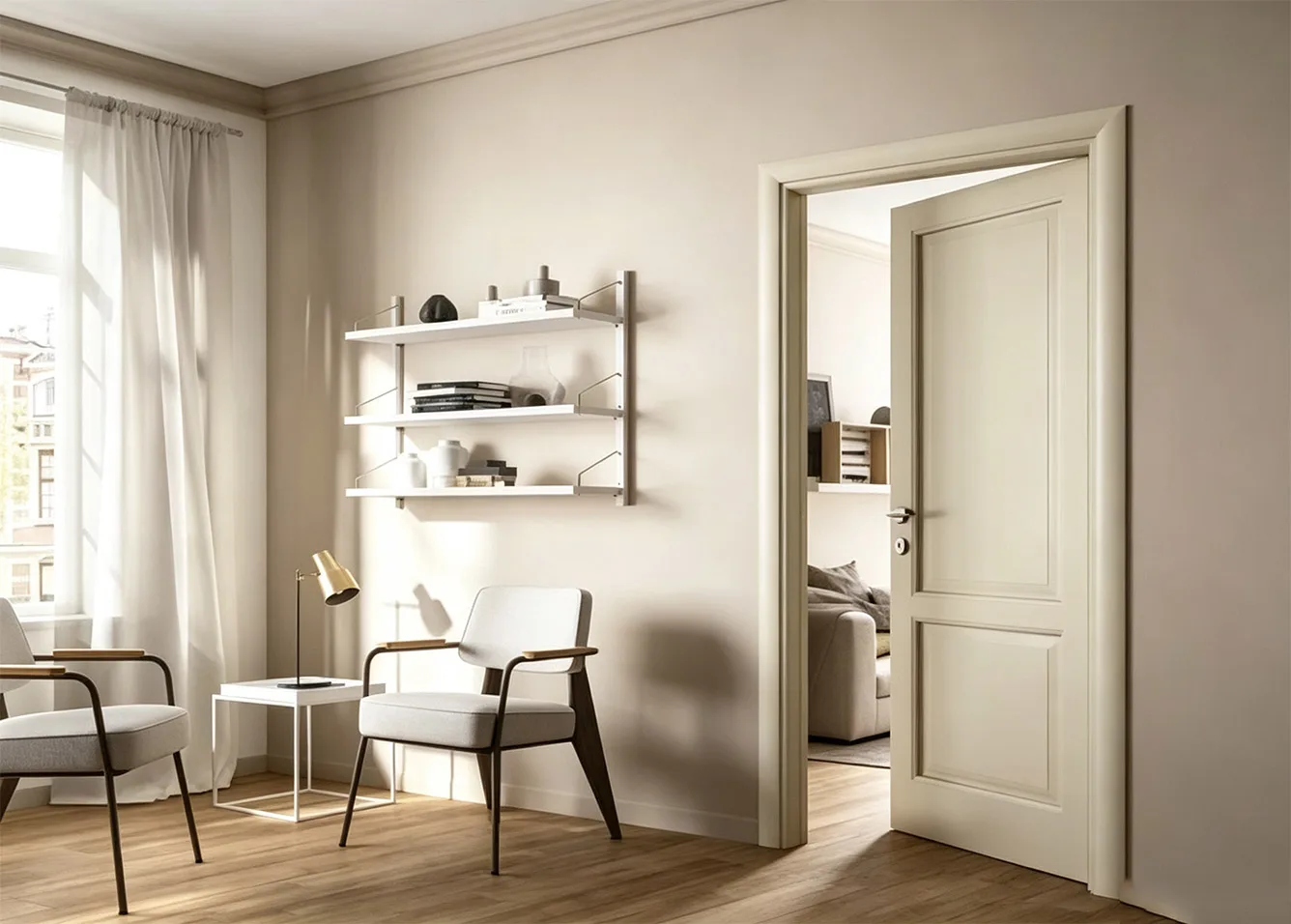
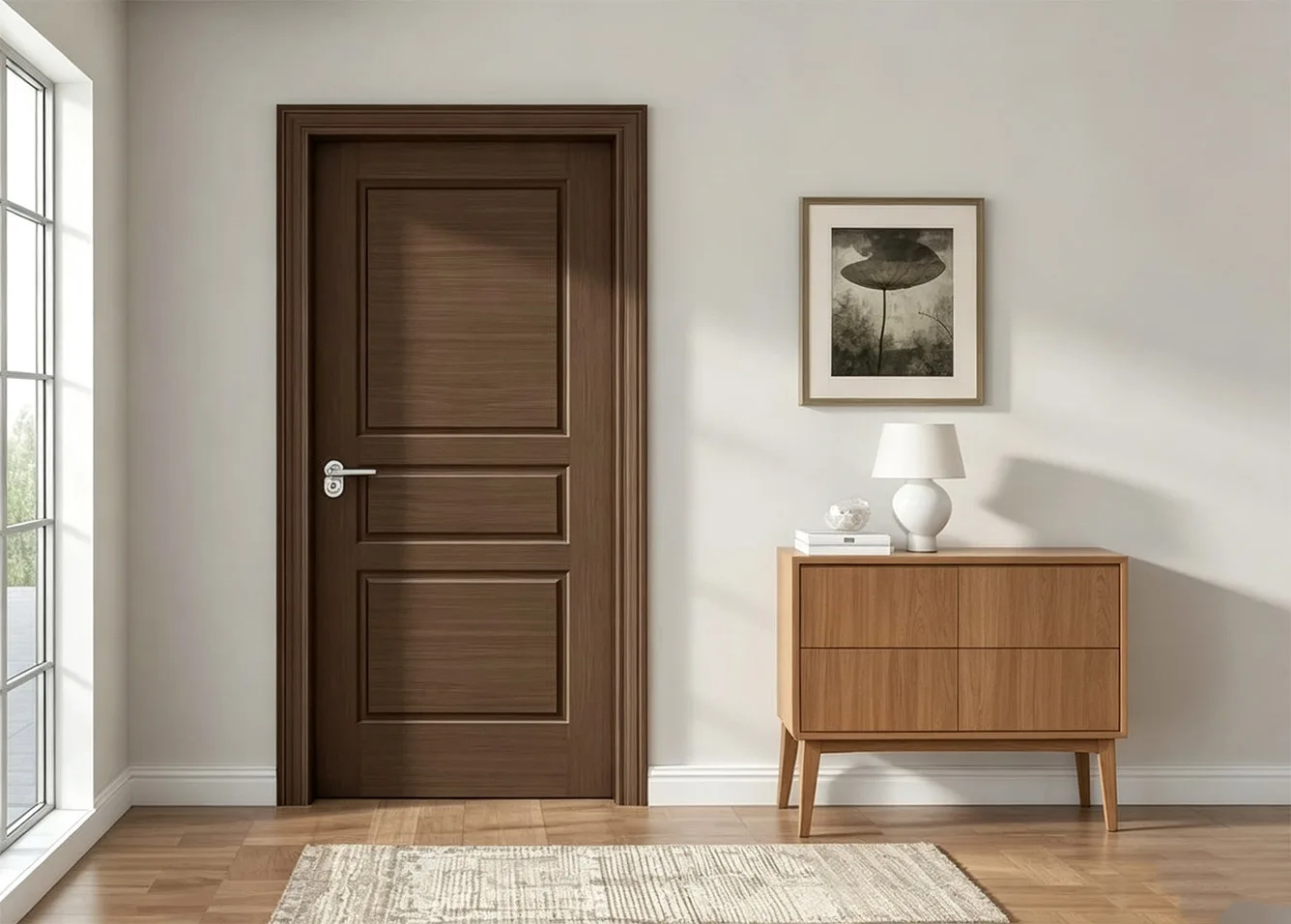
The finished PVC door panels can offer water and moisture resistance, easy-to-clean surfaces, good dimensional stability, and low maintenance requirements, making them suitable for interior doors, decorative doors, and other building applications. Surface embossing, lamination, printing, or other finishing processes can also be configured according to the final product design.
EANS Solution: EANS helps you configure the PVC door making machine from the finished product backward. Based on your target panel width, thickness, PVC formulation, surface design, and production capacity, we match the extruder, screw, die, calibration table, haul-off, cutting, and other downstream equipment to your actual production requirements. Instead of supplying a standard machine package, EANS provides a production-oriented extrusion solution designed around your specific PVC door panel specifications and manufacturing goals.
We value your privacy
We use cookies to enhance your browsing experience, serve personalised ads or content, and analyse our traffic. By clicking "Accept All", you consent to our use of cookies.
Customise Consent Preferences
We use cookies to help you navigate efficiently and perform certain functions. You will find detailed information about all cookies under each consent category below.
The cookies that are categorised as "Necessary" are stored on your browser as they are essential for enabling the basic functionalities of the site. Show more
Necessary cookies are required to enable the basic features of this site, such as providing secure log-in or adjusting your consent preferences. These cookies do not store any personally identifiable data.
Functional cookies help perform certain functionalities like sharing the content of the website on social media platforms, collecting feedback, and other third-party features.
Analytical cookies are used to understand how visitors interact with the website. These cookies help provide information on metrics such as the number of visitors, bounce rate, traffic source, etc.
Performance cookies are used to understand and analyse the key performance indexes of the website which helps in delivering a better user experience for the visitors.
Advertisement cookies are used to provide visitors with customised advertisements based on the pages you visited previously and to analyse the effectiveness of the ad campaigns.