WPC Door Making Machine Passes Factory Trial for Saudi Arabian Project
22 October, 2026
An HDPE pipe production line is an industrial extrusion system that converts high-density polyethylene (HDPE) raw materials into pipes with specified diameters and wall thicknesses. It is designed for continuous pipe manufacturing, serving applications such as water supply, agricultural irrigation, gas distribution and other suitable fluid transportation systems.
This guide explains the main applications of HDPE pipes, how they are manufactured, and the key factors to consider when investing in an HDPE pipe production line. It also covers equipment configuration, production capacity, and line selection to help manufacturers evaluate their production requirements and choose a solution suited to their target market.
An HDPE pipe extrusion line consists of several integrated machines that convert polyethylene raw materials into pipes with specified diameters and wall thicknesses. Each component performs a specific function, from material feeding and extrusion to pipe sizing, cooling, haul-off and cutting. The following table outlines the main components of a standard HDPE pipe production line.
| Component | Quantity |
|---|---|
| Automatic Feeding System | 1 set |
| Single-Screw Extruder | 1 set |
| HDPE Pipe Extrusion Die Head | 1 set |
| Vacuum Calibration Tank | 1 set |
| Cooling Water Tank | 1 set |
| Haul-off Machine | 1 set |
| Pipe Cutting Machine | 1 set |
Note: This is a basic configuration for reference. The number and specifications of vacuum calibration tanks, cooling tanks and haul-off units may vary according to the target pipe diameter, wall thickness, production speed and output requirements. Auxiliary equipment, such as a dosing system, gravimetric feeder, pipe coiler or stacker, can be added when required.
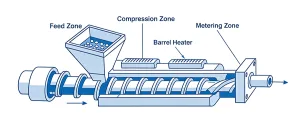
The single-screw extruder is the core machine in an HDPE pipe extrusion line. It conveys, melts, mixes and homogenizes HDPE resin before pushing the molten material through the pipe die head. Its plasticizing performance and output stability directly affect pipe surface quality, dimensional consistency and production efficiency.
Two factors are particularly important when evaluating an HDPE pipe extrusion machine:
For manufacturers planning to produce HDPE water supply pipes, irrigation pipes or other polyethylene pipes, the extruder should be selected according to the target pipe diameter range, required output and resin processing requirements. A larger extruder does not automatically guarantee higher usable output; the die head, cooling system and downstream equipment must also match its capacity.
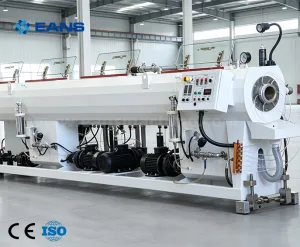
The vacuum calibration tank and cooling water tank work together to establish and stabilize the dimensions of the extruded HDPE pipe. These systems are particularly important when manufacturers need consistent outer diameters, roundness and wall thickness across long production runs.
The vacuum calibration tank uses controlled vacuum and sizing equipment to help the hot pipe maintain its specified outer diameter during the initial forming stage. The calibration sleeve, vacuum level, water distribution and operating speed must be matched to the pipe specification.
The cooling water tank removes heat from the pipe after initial sizing, allowing the material to solidify and retain its shape before downstream handling. Sufficient and uniform cooling helps reduce deformation and dimensional variation, especially when producing pipes at higher output rates.
For B2B buyers comparing HDPE pipe production lines, the key considerations include:
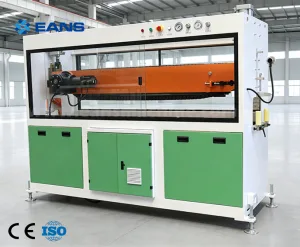
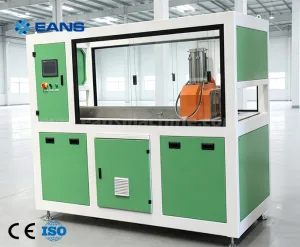
The haul-off machine pulls the pipe through the downstream equipment at a controlled speed. Its traction force and speed must be coordinated with the extruder output to avoid pipe stretching, surface damage or dimensional fluctuations.
The pipe cutting machine cuts the continuously extruded pipe into specified lengths. Depending on the pipe diameter, wall thickness and application, the line may use a suitable saw-cutting or other cutting system. For smaller, flexible pipes, a coiling system may be more appropriate than a standard fixed-length cutting arrangement.
When selecting an HDPE pipe extrusion line, buyers should confirm that the haul-off and cutting systems match the intended pipe range and production speed. This helps ensure that the entire line operates as a coordinated system rather than as a collection of individually sized machines.
The right HDPE pipe production line configuration depends on more than the extruder model. Before requesting a quotation, manufacturers should define the target pipe diameter range, wall thickness or SDR, material grade, required output and intended application.
These specifications determine the appropriate extruder capacity, pipe die head, calibration and cooling arrangement, haul-off configuration and cutting method. Matching the complete line to the intended products helps avoid investing in unnecessary capacity or creating downstream bottlenecks.
EANS can evaluate these requirements to recommend a suitable HDPE pipe extrusion line configuration. Buyers can provide their target pipe sizes, required production capacity and local power supply specifications to obtain a more accurate equipment proposal.
The HDPE pipe manufacturing process uses extrusion technology to convert high-density polyethylene (HDPE) resin into pipes with specified diameters, wall thicknesses and performance requirements. A typical HDPE pipe extrusion process includes material feeding, melting, die forming, vacuum sizing, cooling, haul-off and cutting or coiling. Each stage must be properly controlled to maintain dimensional accuracy, consistent pipe quality and stable production.
HDPE resin pellets are transferred from a storage hopper or material feeding system to the extruder. When required by the product formulation, masterbatch, colorants or other approved additives are proportioned and blended with the base resin before processing.
Consistent material feeding helps maintain a stable supply to the extruder, supporting uniform melt flow and reliable production. Gravimetric dosing or other suitable metering systems can be used when accurate material ratios are required.
HDPE resin generally does not require routine drying under normal, properly stored processing conditions. However, wet, contaminated or improperly stored material should be evaluated and handled according to the resin supplier’s recommendations. Material preparation requirements depend on the resin grade, additives and storage conditions.
The single-screw extruder conveys the HDPE resin through a heated barrel. As the screw rotates, the material is heated, melted and homogenized to form a continuous melt suitable for pipe extrusion.
The screw design, barrel temperature profile, screw speed and material feed rate all influence plasticizing performance and output stability. Appropriate processing conditions help prevent defects associated with incomplete melting, excessive thermal exposure or unstable melt flow.
For manufacturers, a properly matched HDPE pipe extrusion machine is essential for achieving the required production capacity while maintaining consistent melt quality. The extruder must be selected according to the intended pipe diameter range, wall thickness, resin grade and output target.
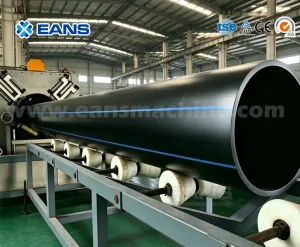
The molten HDPE passes through a pipe extrusion die head, which shapes the material into a continuous tubular profile. The die design and operating conditions determine the initial pipe geometry and influence the distribution of material around the pipe circumference.
For applications requiring identification stripes, such as certain water supply pipes, a compatible co-extrusion system introduces colored HDPE material through a dedicated stripe channel in the die head. The stripes are formed on the pipe surface during extrusion, eliminating the need for a separate printing operation for those stripes.
The die head, mandrel, melt distribution and extrusion conditions must be matched to the target pipe diameter and wall thickness. Proper setup helps achieve consistent pipe geometry and stripe placement.
After leaving the die head, the hot pipe enters the vacuum calibration system. Controlled vacuum holds the pipe against a sizing sleeve to help establish the required outer diameter and maintain its shape during initial cooling.
The pipe then passes through one or more cooling tanks, where circulating water removes heat and allows the material to solidify. The required cooling arrangement depends on pipe diameter, wall thickness, production speed and the line’s thermal capacity.
Correct calibration and cooling conditions help control outer diameter, roundness and dimensional stability. However, wall thickness consistency also depends on die design, melt stability, material flow and haul-off speed. These factors must be controlled together to achieve the specified pipe dimensions.
The haul-off machine pulls the pipe through the calibration and cooling sections at a controlled speed. Its traction force and operating speed must be synchronized with the extruder output to maintain stable production.
If the haul-off speed is too high or too low relative to material output, the pipe may develop dimensional variations or unstable wall thickness. Excessive traction can also affect the pipe’s dimensions, while insufficient traction may cause slipping or inconsistent movement.
For this reason, haul-off speed, extruder output and cooling conditions should be adjusted as a coordinated system rather than independently.
Once the pipe has cooled sufficiently and reached the required dimensions, it moves to the finishing section. Depending on the product specification, the line uses an automatic cutting machine to cut rigid pipes into preset lengths, followed by a stacking or collection system.
For smaller-diameter, flexible HDPE pipes supplied in coils, a suitable pipe coiler can replace the standard fixed-length cutting and stacking arrangement. The finishing equipment is selected according to pipe diameter, wall thickness, stiffness, required delivery length and handling requirements.
After cutting or coiling, the finished pipes can be inspected for dimensional compliance, surface defects, marking requirements and other applicable product standards before packaging and storage.
Consistent HDPE pipe quality depends on the complete extrusion process, not on a single machine. The main control factors include:
Manufacturers should also verify that the finished pipes meet the dimensional, mechanical and application-specific standards required in their target markets.
EANS can help buyers select an HDPE pipe extrusion line configuration based on the intended pipe diameter range, wall thickness, production capacity and product application. Providing these specifications at the quotation stage helps determine the appropriate extruder, die head, calibration and cooling system, haul-off and finishing equipment.
Investing in an HDPE pipe making machine is a long-term production decision, not just an equipment purchase. For pipe manufacturers, the real value lies in controlling labor and energy costs, improving material utilization and maintaining consistent output. These factors should be evaluated alongside the initial machine price when comparing HDPE pipe production lines.
An automated HDPE pipe production line coordinates material feeding, extrusion, haul-off and cutting to reduce routine manual handling. Depending on the line configuration, automatic feeding, synchronized controls and automatic length cutting can help operators manage production more efficiently and reduce the need for frequent manual adjustments.
The actual labor savings depend on the level of automation, factory layout and production requirements. Buyers should therefore compare the expected staffing needs and daily operating workload of the complete line rather than judging automation by individual machine features alone.
Electricity consumption is an important part of HDPE pipe manufacturing costs. An appropriately selected extruder drive, efficient barrel heating, thermal insulation and accurate temperature control can help reduce unnecessary energy use while maintaining stable processing conditions.
Servo-driven systems may improve energy efficiency in suitable applications by adjusting motor output to operating demand. However, savings vary with equipment design, pipe specifications and production conditions. Buyers should compare actual or estimated electricity consumption per kilogram of finished pipe under comparable operating conditions instead of relying on general energy-saving claims.
Raw material costs directly affect the economics of HDPE pipe production. Stable extrusion and accurate process control help reduce start-up waste, dimensional variation and rejected pipes, improving the amount of saleable product obtained from the raw material used.
Where permitted by the intended application and applicable standards, suitable recycled polyethylene may also be considered as part of the material strategy. Its use depends on material quality, traceability, compatibility and product requirements. Recycled material must not be assumed suitable for every pipe application, particularly regulated drinking-water and gas systems.
For manufacturers, the priority is to balance material cost with consistent processing and compliance with the required pipe standards.
The lowest initial quotation does not necessarily deliver the lowest manufacturing cost. Before investing, compare the complete line’s expected output, staffing requirements, energy consumption, material waste, maintenance needs and technical support.
EANS helps manufacturers select HDPE pipe extrusion line configurations according to their target pipe diameters, wall thicknesses, production capacity and application requirements. Providing these details allows the equipment configuration to be matched to the intended production goals and helps buyers make a more informed investment decision.
Even with a properly configured HDPE pipe production line, process variations can lead to defects such as uneven wall thickness and rough pipe surfaces. These problems are often related to material conditions, die performance, extrusion stability or downstream sizing and cooling. Identifying the cause at the relevant production stage helps manufacturers correct defects, reduce material waste and maintain consistent pipe quality.
Possible causes: Uneven melt distribution at the die head, incorrect die centering, unstable melt pressure or inconsistent haul-off speed can cause wall thickness to vary around the pipe circumference or along its length.
How to fix it:
Prevention tip: Stable extrusion output, accurate die alignment and coordinated haul-off control help maintain consistent wall thickness and reduce rejected pipes.
Possible causes: A rough or irregular surface may result from unsuitable melt temperature, poor material melting, excessive shear, die deposits or unstable extrusion conditions. Wavy patterns may also be associated with inconsistent melt flow, uneven cooling or unstable vacuum sizing.
How to fix it:
Prevention tip: Consistent material quality, appropriate temperature settings, a clean die head and stable calibration and cooling conditions help produce a smoother, more uniform HDPE pipe surface.
If these problems continue after operating parameters have been checked, the issue may involve the die design, sizing system, cooling capacity or coordination between the extruder and downstream equipment. Selecting an HDPE pipe production line according to the target pipe diameter, wall thickness, resin grade and required output helps reduce the risk of recurring production problems.
EANS can assess these requirements when recommending an HDPE pipe extrusion line configuration, helping manufacturers match the equipment to their intended pipe specifications and production conditions.
Before choosing an HDPE pipe production line, define your product requirements, target output and budget. These details help suppliers recommend a suitable configuration and provide a more accurate quotation.
Pipe specifications: Confirm the required diameter range, wall thickness and intended application.
Production capacity: Specify your target output and daily operating hours.
Quotation scope: Check which equipment, molds and auxiliary systems are included in the price.
Technical support: Confirm the availability of installation, operator training, spare parts and after-sales service.
Comparing these factors helps you evaluate equipment proposals based on your actual production needs, rather than price alone.
Get an HDPE Pipe Production Line Quote from EANS
Looking for an HDPE pipe extrusion line for your factory? Contact EANS with your target pipe sizes, required output and application. Our team can assess your requirements and discuss a suitable equipment configuration and quotation.