What is PVC Roofing Sheet?
20 September, 2026
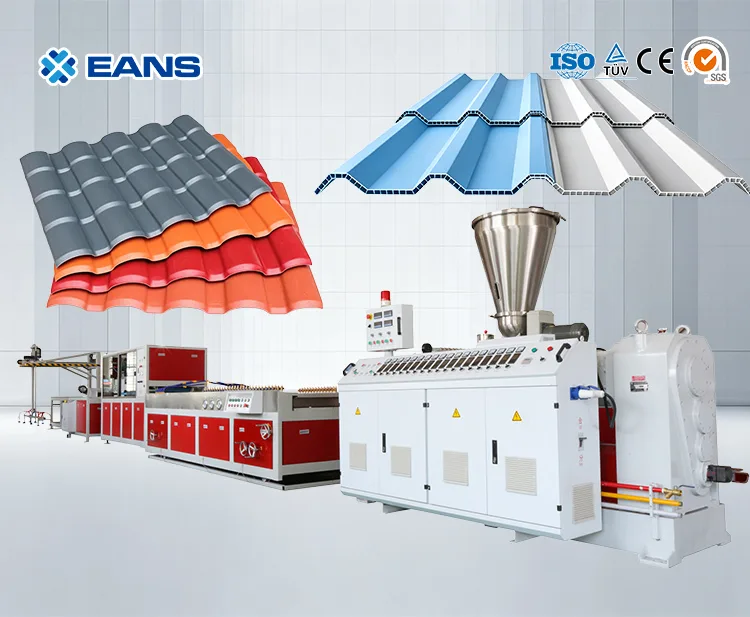
PVC roofing sheets are typically manufactured through a continuous extrusion process. PVC resin is first compounded with stabilizers, fillers, pigments, and other additives. The prepared material is then fed into an extruder, plasticized, passed through a sheet die, formed into the required roofing profile, cooled, hauled off, and cut to length. Multi-layer sheets may require additional co-extruders, ASA cap-layer systems, film-lamination equipment, or reinforcement units.
PVC roofing sheets are not made with a single structure. Depending on the application environment, required performance, material formulation, and production cost, manufacturers may use different constructions, including single-layer PVC extrusion, ASA co-extrusion, multi-layer composite structures, and fiberglass-reinforced designs. These structural differences directly affect the extruder configuration, die design, layer combination method, and downstream forming process used in production.
Understanding the PVC Roofing Sheet Manufacturing Process is therefore important for evaluating how different roofing sheet structures are produced and what equipment each structure requires. The following sections examine four typical PVC roofing sheet structures, explaining their material composition, manufacturing methods, and the main differences in PVC roofing sheet production line equipment.
This article focuses on rigid or semi-rigid PVC roofing sheets produced by extrusion, including corrugated, trapezoidal and tile-style panels. It does not cover flexible single-ply PVC roofing membranes used on flat or low-slope commercial roofs.
The PVC roofing sheet manufacturing process has evolved from simple single-layer extrusion to multi-layer structures that combine weather-resistant surfaces, film lamination, and fiberglass reinforcement. These structural changes are not only related to the final roofing sheet performance but also directly affect the configuration of the PVC roofing sheet production line.
Depending on the required weather resistance, mechanical strength, product appearance, material formulation, and target application, manufacturers may produce single-layer PVC sheets, PVC + ASA co-extruded sheets, ASA film-laminated structures, or fiberglass-reinforced composite roofing sheets.
For equipment buyers, understanding these differences is important because each structure requires a different combination of extrusion, co-extrusion, lamination, forming, and downstream equipment. The following four structures show how PVC roofing sheet manufacturing develops from basic extrusion to more advanced composite production.

A Single-Layer PVC roofing sheet consists of one continuous layer of rigid PVC without an additional ASA surface layer or fiberglass reinforcement.
Because the entire sheet is made from PVC, its basic performance depends mainly on the material formulation, plasticization quality, sheet thickness, and accuracy of the downstream forming process.
This is the most straightforward structure in the PVC roofing sheet manufacturing process and generally requires a simpler production line configuration than multi-layer roofing sheets.
How It’s Made
PVC raw materials are fed into the extrusion system, where they are heated, plasticized, and homogenized. The molten PVC then passes through a T-Die, which continuously forms the material into a flat sheet.
Depending on the final roofing profile, the hot sheet can then enter a suitable forming and calibration section to produce corrugated, trapezoidal, or other required cross-sectional shapes. Some configurations may also incorporate rolling or embossing equipment when surface texture or thickness control is required.
The formed sheet is subsequently cooled, hauled off, and cut to the required length.
A typical PVC roofing sheet making machine for this structure therefore consists mainly of the PVC extrusion system, T-Die, forming and calibration equipment, haul-off, and cutting equipment.
A PVC + ASA Co-Extruded Roofing Sheet combines a rigid PVC structural layer with an ASA weather-resistant surface layer.
The PVC layer forms the main body of the sheet, providing rigidity, waterproof performance, and chemical resistance. The ASA surface layer is designed to improve resistance to UV exposure and outdoor weathering while helping maintain the appearance of the roofing sheet.
Compared with a single-layer PVC structure, this design adds a dedicated weather-resistant surface without requiring the entire sheet to be manufactured from ASA.

How It’s Made
The PVC and ASA materials are processed through separate extrusion systems.
The main extruder plasticizes the PVC material, while a secondary extruder processes the ASA material. The two molten materials are then combined through a co-extrusion die, forming a continuous PVC + ASA composite structure.
After leaving the die, the hot sheet enters the appropriate forming and calibration section to obtain the required roofing profile. Cooling, haul-off, and cutting then complete the continuous production process.
The main difference between this configuration and a single-layer PVC roofing sheet extrusion line is the addition of an ASA extrusion system and a co-extrusion die.
For manufacturers producing corrugated or trapezoidal roofing sheets, the forming section must also be matched to the required profile rather than treated as a universal component.
The third structure combines a PVC substrate with ASA film lamination and an ASA co-extruded surface layer.
A typical construction can be understood as:
PVC Substrate + ASA Film + ASA Co-Extruded Protective Layer
The ASA film provides an additional surface treatment and appearance option, while the ASA co-extruded layer provides further weather-resistant protection.
Compared with conventional PVC + ASA co-extrusion, this structure introduces an additional online film-lamination stage, making the production process and equipment configuration more complex.
How It’s Made
PVC material is first plasticized through the main extrusion system and continuously formed through a T-Die.
An online ASA film lamination unit then applies the ASA film to the appropriate surface of the sheet. The lamination process requires coordinated control of sheet temperature, film tension, and bonding pressure to achieve stable and uniform contact.
The ASA material is also processed through a dedicated extrusion system to form the required co-extruded protective layer.
After the composite structure has been formed, the sheet passes through the downstream forming and calibration section before cooling, haul-off, and cutting.
Therefore, compared with a standard PVC Roofing Sheet Making Machine, this configuration requires additional film-lamination equipment and a more integrated material-handling and process-control system.
The PVC + PVC + Fiberglass + ASA Film Roofing Sheet adds a continuous fiberglass reinforcement layer between two PVC layers and uses ASA film as the outer weather-resistant surface.

The typical layer structure from top to bottom is:
This structure is commonly associated with fiberglass-reinforced synthetic resin roofing sheets used in industrial and corrosive environments.
The ASA film provides weather protection, the two PVC layers form the main waterproof and corrosion-resistant body, and the fiberglass mesh acts as the internal reinforcement that improves dimensional stability and mechanical performance.
How It’s Made
This structure requires a more complex PVC roofing sheet extrusion line because several continuous processes must operate together.
The general manufacturing sequence is:
Dual PVC Extrusion → T-Die → Online Fiberglass Lamination → ASA Film Lamination → Two-Roll Calender → Forming & Calibration → Cooling → Haul-Off → Cutting
Two PVC extrusion systems first plasticize the upper and lower PVC layers. The molten PVC is then formed into a continuous sheet through the T-Die.
During the continuous extrusion process, fiberglass mesh is fed from a dedicated unwinding system and introduced between the PVC layers. The fiberglass becomes embedded within the composite structure, creating the internal reinforcement layer.
An ASA film lamination system then applies the weather-resistant film to the outer surface.
The composite sheet can subsequently pass through a Two-Roll Calender to control thickness and surface quality. Depending on the product design, the rollers can also provide an embossed surface finish.
The sheet then enters a roller-type forming and calibration section, where the roofing profile is continuously stabilized before cooling, haul-off, and cutting.
This configuration requires closer coordination between extrusion output, fiberglass tension, lamination conditions, sheet temperature, forming speed, and downstream conveying than a conventional single-layer roofing sheet line.
| Structure | Main Materials | Function | Typical Applications |
| Single-Layer PVC | Rigid PVC | Provides basic waterproofing, corrosion resistance, rigidity, and weather protection with a simple single-material structure. | Agricultural sheds, carports, storage buildings, temporary structures, workshops, and cost-sensitive roofing projects. |
| PVC + ASA Co-Extrusion | Rigid PVC + ASA | Uses PVC as the structural body and ASA as the outer weather-resistant layer to improve UV resistance, color retention, and long-term outdoor durability. | Industrial factories, warehouses, commercial buildings, agricultural facilities, workshops, and outdoor structures exposed to sunlight and rain. |
| PVC + ASA Film + ASA Co-Extrusion | PVC + ASA Film + ASA | Combines the structural performance of PVC with ASA film and an ASA protective layer for enhanced surface protection, weather resistance, and appearance. | Commercial and industrial buildings, agricultural roofing, decorative projects, and outdoor applications requiring durable, attractive surfaces. |
| PVC + PVC + Fiberglass + ASA Film | PVC + PVC + Fiberglass + ASA Film | Combines waterproof and corrosion-resistant PVC layers with fiberglass reinforcement for improved dimensional stability, mechanical strength, and resistance to thermal deformation, while ASA protects the outer surface. | Large-span industrial factories, warehouses, livestock buildings, chemical plants, coastal buildings, corrosive industrial environments, and roofing projects requiring higher structural stability. |
The four structures should not be treated as four completely different types of roofing sheet machines. Instead, they represent different levels of material and process integration within a PVC Roofing Sheet Production Line.
A single-layer PVC product mainly requires a PVC extrusion and forming system. Adding an ASA layer introduces a co-extrusion system and a dedicated co-extrusion die. When ASA film lamination is added, the PVC Roofing Sheet Making Machine must incorporate an online film-lamination unit. For fiberglass-reinforced roofing sheets, the line requires additional fiberglass feeding and lamination equipment, together with the downstream equipment required to stabilize the reinforced composite sheet.
Therefore, when selecting a PVC Roofing Sheet Machine, manufacturers should first define the target sheet structure, required weather resistance, reinforcement requirements, surface finish, and final roofing profile. The production line can then be configured around those product requirements rather than selecting equipment based only on the general term “PVC roofing sheet.”
For EANS, the appropriate PVC Roofing Sheet Production Line can be configured according to the required roofing structure, material combination, profile, and target market, with the extrusion, co-extrusion, lamination, forming, and downstream equipment matched to the actual product specification.
For manufacturers planning a new project or upgrading an existing setup, EANS can develop a suitable solution based on the required roofing structure and production requirements, covering the necessary extrusion, co-extrusion, film lamination, fiberglass reinforcement, forming, and cutting processes.
If you are planning to produce a specific type of PVC roofing sheet, EANS can help match the material structure, processing method, and equipment configuration to your product requirements. Share your target sheet structure, profile, dimensions, and production capacity, and our team can develop a corresponding production line solution for your project.