How Is PVC Roofing Sheet Manufactured?
23 September, 2026
PVC roofing sheets are plastic roofing materials made mainly from polyvinyl chloride (PVC) and produced by extrusion into corrugated, trapezoidal, tile-style, or other roofing profiles. It is commonly used for industrial buildings, warehouses, agricultural facilities, workshops, and other roofing applications where lightweight construction, corrosion resistance, and weather resistance are important.
For manufacturers planning to produce PVC roofing sheets, understanding the finished product is only the first step. Material formulation, roofing sheet profiles, extrusion processes, production equipment, output requirements, and line configuration all affect the final production solution.
This guide covers the key features and applications of PVC roofing sheets, their manufacturing process, the main equipment used in production, and the factors to consider when choosing a PVC roofing sheet production line. Do not confuse it with the flexible PVC single-ply roofing membrane used on many flat and low-slope commercial roofs in the United States.
PVC roofing sheets are used across several building and industrial applications, but the reasons for choosing them are not the same in every market. The required roofing performance can vary significantly depending on whether the sheet is used in a chemical plant, livestock facility, warehouse, or commercial building.
For manufacturers, understanding these application differences is important because they directly affect the required sheet structure, profile, thickness, formulation, and production specifications.


Chemical plants, fertilizer facilities, metal-processing plants, and other industrial sites may expose roofing materials to corrosive gases, chemical residues, high humidity, or salt-laden air.
In these environments, corrosion resistance is the primary consideration. PVC does not rust like conventional steel roofing, making it a suitable material for applications where corrosion can shorten the service life of metal roofing.
For manufacturers serving this market, the focus is therefore on chemical resistance, long-term outdoor exposure, sheet strength, and the appropriate PVC formulation. The actual formulation should be selected according to the specific chemicals and environmental conditions involved.
The requirements of livestock buildings are different from those of industrial plants. Poultry houses and livestock facilities typically need to manage humidity, ammonia exposure, indoor temperature, and noise.
Ammonia and moisture generated inside these buildings can create a challenging environment for conventional metal roofing. PVC roofing sheets can be considered where resistance to this type of corrosive environment is required.
Another consideration is rain noise. Compared with some metal roofing systems, PVC has sound-damping characteristics that can reduce the transmission of rain noise through the roof. For poultry and livestock projects, manufacturers may therefore pay more attention to sheet thickness, profile structure, thermal performance, and acoustic characteristics rather than focusing only on basic weather resistance.
Agricultural buildings cover a broader range of applications, including farm workshops, storage sheds, crop-processing areas, and equipment shelters.
Here, the main requirements are often cost-effective roofing, sufficient structural strength, easy installation, and resistance to outdoor weather conditions. The roof may also need to cover relatively large areas, making sheet width and profile design important factors.
For manufacturers targeting this market, profile geometry, sheet dimensions, production speed, and material consumption can have a direct effect on the competitiveness of the finished product.
For warehouses and storage buildings, the key issue is often not chemical resistance but large-area roofing efficiency and structural requirements.
Roofing sheets may need to cover large spans while maintaining sufficient stiffness without adding unnecessary weight. This makes the relationship between sheet thickness, profile depth, width, and supporting structure particularly important.
From a manufacturing perspective, buyers may therefore look for production lines capable of producing consistent dimensions and different profiles, allowing one equipment setup to serve multiple warehouse and industrial-building projects through suitable mold configurations.
Commercial buildings, parking structures, workshops, canopies, and similar projects place greater emphasis on appearance and product consistency alongside basic roofing performance.
Color, surface finish, profile design, dimensional accuracy, and resistance to outdoor discoloration can become important purchasing factors, particularly when the roof is highly visible.
Manufacturers serving this segment may therefore need greater flexibility in profile design, color options, surface treatment, and product dimensions rather than simply maximizing production output.


Different end-use markets require different PVC roofing sheet specifications. A chemical facility may prioritize chemical resistance, while a livestock building may place greater emphasis on corrosion resistance and acoustic performance. Agricultural and warehouse projects may focus more on profile design, structural requirements, material consumption, and production cost, while commercial applications can place greater importance on appearance and dimensional consistency.
These differences should be defined before selecting a PVC Roofing Sheet Production Line, because the target products determine the required extrusion capacity, die design, calibration system, haul-off speed, cooling configuration, and cutting system.
The performance and production cost of a PVC roofing sheet are closely related to its material formulation, cross-sectional structure, and extrusion process. For manufacturers, the PVC roofing sheet manufacturing process is not simply about forming PVC into a roofing profile. The extrusion system, material formulation, co-extrusion structure, roofing sheet profile, die design, calibration, cooling, and haul-off all need to be matched to the final product.
Two common approaches in PVC roofing sheet production are multi-layer co-extrusion and hollow multi-wall extrusion. The appropriate process depends on the required weather resistance, mechanical properties, thermal performance, appearance, material consumption, and production capacity.
ASA-PVC co-extrusion is used when the roofing sheet requires an additional weather-resistant surface layer. Instead of producing the entire sheet from one PVC formulation, different materials are plasticized separately and combined through a co-extrusion distribution system before entering the forming die. The typical structure consists of an ASA surface layer and a PVC body layer.
ASA surface layer
ASA, or Acrylonitrile Styrene Acrylate, is used as the outer surface material because of its resistance to outdoor weathering and UV exposure. In an ASA-PVC roofing sheet, the ASA layer is positioned on the exposed surface to provide additional protection for the underlying PVC structure.
Its actual outdoor performance depends on the ASA grade, formulation, layer thickness, sheet structure, climate, UV exposure, and installation conditions. Therefore, the ASA layer should be selected according to the intended application rather than treated as a universal solution for all roofing environments.
PVC core and bottom layers
The main body of the roofing sheet is normally based on PVC resin combined with processing additives, stabilizers, impact modifiers, fillers, and other formulation components according to the product requirements.
The PVC formulation and cross-sectional design influence important production and product characteristics such as stiffness, impact resistance, dimensional stability, material consumption, and processing behavior.
One of the main advantages of a multi-layer structure is that different functions can be assigned to different layers. The surface layer can provide additional weathering protection, while the PVC body provides the main structural section of the sheet. This allows manufacturers to balance product performance, material usage, and production cost.

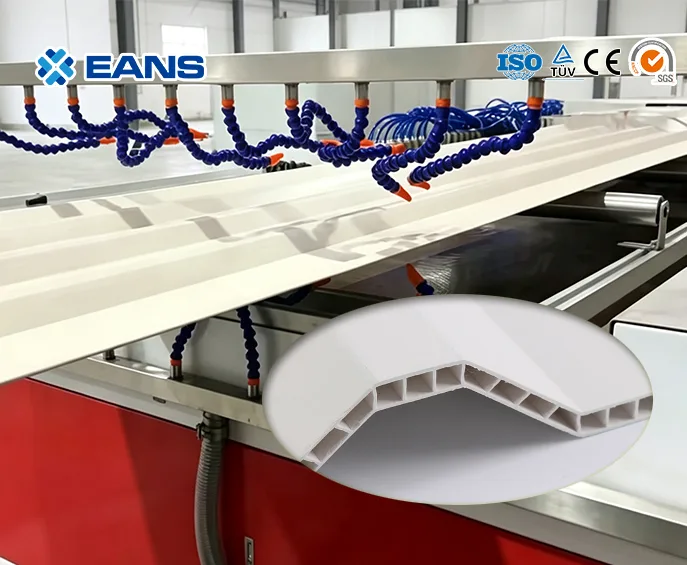
Another important design used in PVC roofing sheet production is the hollow multi-wall structure. Instead of producing a completely solid cross-section, the sheet is formed with continuous internal cavities through a specially designed hollow extrusion die.
The enclosed air spaces can reduce heat transfer compared with a solid structure of similar overall dimensions. However, the actual thermal performance depends on the cavity geometry, wall thickness, material formulation, installation method, and surrounding environmental conditions.
A hollow structure can also influence material consumption and product weight. For manufacturers, the challenge is to achieve the required balance between thermal insulation, mechanical strength, dimensional stability, and material usage.
The internal structure also has a direct effect on the production equipment. Hollow multi-wall roofing sheets generally require a dedicated extrusion die and a downstream calibration and cooling system that matches the cavity design. The haul-off speed, cooling conditions, and calibration accuracy must remain stable to maintain the dimensions and geometry of the finished sheet.
Different PVC roofing sheet structures require different equipment configurations. For example, an ASA-PVC co-extrusion sheet may require multiple extrusion units and a co-extrusion distribution system, while a hollow multi-wall sheet requires a forming die designed for its internal cavity structure.
| Equipment | Main Function | When It Is Required |
| PVC Extruder | Plasticizes, mixes, and conveys the PVC compound at a controlled temperature and output. | Required for standard PVC roofing sheet extrusion. |
| Co-Extruder | Processes ASA or another functional material for the surface layer. | Used for ASA-PVC co-extrusion or other multi-layer structures. |
| Extrusion Die | Forms the molten material into the required roofing sheet profile and cross-sectional structure. | Selected by profile, width, thickness, and structure. |
| Calibration & Cooling System | Stabilizes the sheet dimensions and cools the extruded material after forming. | Required to maintain dimensional accuracy and production stability. |
| Haul-Off Machine | Pulls the formed sheet through the downstream equipment at a controlled speed. | Maintains consistent speed and sheet dimensions. |
| Cutting Machine | Cuts the continuous roofing sheet into the required lengths. | Selected according to finished sheet length and cutting requirements. |
| Stacking Equipment | Collects and organizes the cut roofing sheets for handling and packaging. | Used when automatic sheet collection and stacking are required. |
The final equipment configuration should therefore be determined by the roofing sheet profile, sheet width and thickness, layer structure, target output, material formulation, and required production speed rather than by the extruder model alone.
EANS can configure the PVC roofing sheet production line according to the target product, including ASA-PVC co-extrusion, hollow multi-wall structures, and other customized sheet designs. The equipment configuration can be matched to the required sheet specifications and production capacity.
For manufacturers planning a PVC roofing sheet making machine, production economics depend on more than the rated output of the extrusion machine. Material utilization, production waste, product flexibility, tooling requirements, and the ability to produce different roofing sheet profiles can all affect the overall manufacturing cost and operating efficiency.
PVC is a thermoplastic material, which means suitable production scrap can be processed and reused under controlled conditions. During PVC roofing sheet extrusion, manufacturers may generate edge trim, start-up material, off-spec sheets, and other production waste.
Depending on the material formulation and product requirements, suitable PVC scrap can be processed through a plastic crusher or pulverizer and returned to the production process. For multi-layer roofing sheets, recycled material may be considered for appropriate core or bottom layers, while the surface layer may require tighter control of material quality and formulation.
The allowable recycled material ratio is not a fixed percentage. It depends on factors such as the PVC formulation, recycled material quality, contamination level, product structure, and required mechanical and surface properties. Excessive or poorly controlled recycled material can affect processing stability, dimensional consistency, and finished-sheet performance.
For this reason, an efficient PVC roofing sheet manufacturing process should consider material recovery as part of the overall production system. Matching the recycling equipment, material handling system, and extrusion process can help reduce material loss and improve raw material utilization.
Another important production advantage is the ability to manufacture different PVC roofing sheet profiles using a compatible extrusion platform.
The main extrusion system, feeding equipment, and some upstream material preparation equipment can serve multiple products, while the extrusion die, calibration system, forming equipment, and downstream configuration may need to be changed or adjusted according to the target roofing sheet.
Common product structures include:
Corrugated PVC Roofing Sheet: A continuous corrugated cross-section provides the required profile geometry for applications such as agricultural buildings, workshops, warehouses, and other roofing structures.
Trapezoidal PVC Roofing Sheet: The trapezoidal profile is commonly used for industrial and storage buildings. Sheet width, thickness, profile depth, and supporting structure can be selected according to the intended application and local market requirements.
Spanish Wave or Tile-Profile Roofing Sheet: A tile-shaped or wave-shaped surface can be produced using dedicated forming or embossing equipment to create a more traditional roofing appearance for residential and commercial applications.
The ability to change molds and adjust downstream equipment gives manufacturers greater flexibility when producing multiple roofing sheet specifications. However, this does not mean that every roofing profile can be produced by simply changing the die. Product dimensions, cross-sectional structure, sheet thickness, forming method, cooling requirements, and target output can determine whether additional equipment or configuration changes are necessary.
For manufacturers planning to produce several roofing sheet profiles, these requirements should be considered when selecting the PVC roofing sheet extrusion line. A production line designed around the planned product range can reduce unnecessary equipment duplication while providing the flexibility needed for future product changes.
Choosing a PVC roofing sheet production line should be based on the target product, material formulation, sheet dimensions, and required output rather than extruder power alone.
For many rigid PVC roofing sheets, a conical twin screw extruder is commonly used for PVC dry-blend processing. The screw design, temperature control, and extrusion output should match the material formulation and product specifications.
PVC is sensitive to excessive heat and shear, so stable plasticization and temperature control are important for consistent output. If the formulation contains abrasive fillers such as calcium carbonate, appropriate screw and barrel wear protection should also be considered.

The extrusion die determines the final roofing sheet profile, width, thickness, and cross-sectional structure. For ASA-PVC roofing sheets, the co-extrusion system must distribute the ASA and PVC layers evenly across the sheet width.
The ASA layer should be controlled according to the product design and weathering requirements. Excessive thickness increases material consumption, while uneven distribution can affect surface consistency. For hollow multi-wall sheets, the die must also form the required internal cavities and work with the downstream calibration system.
The downstream equipment must match the extrusion output and profile design. Calibration and cooling stabilize the sheet dimensions, while the haul-off maintains a consistent pulling speed. The cutting system then cuts the continuous sheet to the required length.
The extrusion output, cooling capacity, haul-off speed, and cutting operation need to remain coordinated. Poor matching between these stages can result in profile deformation, unstable dimensions, or inconsistent sheet length.


Key Parameters for Line Selection
| Parameter | Main Consideration |
| Sheet width & thickness | Die size and line capacity |
| Profile structure | Die and calibration design |
| Layer structure | Single-layer or co-extrusion |
| Material formulation | Extruder and screw configuration |
| Target output | Extruder and downstream capacity |
| Production speed | Cooling and haul-off requirements |
| Sheet length | Cutting configuration |
EANS can configure the PVC roofing sheet production line according to the target sheet structure, specifications, and production capacity, including standard PVC, ASA-PVC co-extrusion, and customized roofing sheet profiles.
The success of a PVC roofing sheet manufacturing project depends on the right combination of material formulation, extrusion technology, and equipment configuration. Understanding factors such as co-extrusion structure, temperature control, die design, cooling, and downstream forming helps manufacturers select a production line that matches their target products and output requirements.
With the right process and equipment configuration, manufacturers can improve production stability, control material consumption, and produce consistent roofing sheet profiles for different market applications.