WPC Door Making Machine Passes Factory Trial for Saudi Arabian Project
22 October, 2026
Choosing a PVC window profile production line starts with defining the profiles you plan to produce, their specifications, and your target output. Different window and door systems require different profile cross-sections, dimensions, and tooling, which directly affect the extrusion line configuration and production capacity. Before comparing quotations, manufacturers should evaluate whether the proposed line can meet their product requirements, maintain consistent profile quality, and support their planned production volume.
Two quotations can list the same extruder size and offer very different production capabilities. One may include tooling for a complete window system, while the other includes only one profile die. Their quoted output may also refer to different compounds, section weights, cooling conditions, and quality limits.
Choose a PVC window profile production line by the products it must manufacture and the accepted output it must deliver. For engineers and procurement managers, the selection process should connect drawings, formulation, tooling, downstream equipment, factory utilities, and a measurable acceptance trial.
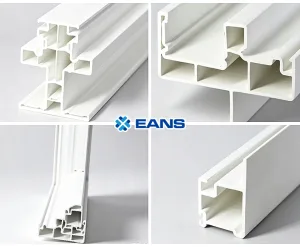
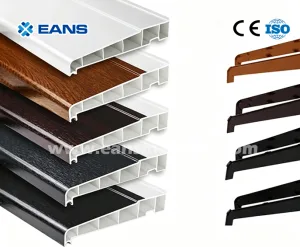
Rigid PVC window profiles, often called uPVC or PVC-U profiles, are extruded sections that fabricators later turn into windows. Frame, sash, mullion, transom, glazing bead, and accessory sections must work together.
Specify the complete product range before comparing machinery. Identify the first products to enter production, their expected order volumes, and any future sections that justify reserved capacity. A wider operating range is useful only when the supplier defines the products and tooling it supports.
Prepare one inquiry package and send the same version to each supplier:
| Buyer input | Details to provide | What it determines |
|---|---|---|
| Profile drawings | Walls, chambers, grooves, reinforcement spaces, mating features, and tolerances | Die, calibration tooling, handling, and inspection |
| Material specification | Compound, feed form, filler characteristics, recycled content, and color | Feeding, screw design, process window, and wear requirements |
| Production demand | Accepted metres by product, operating hours, batch sizes, and changeovers | Line capacity and production scheduling |
| Surface and layer design | Plain color, decorative film, cap layer, core material, or integrated seal | Co-extrusion, finishing equipment, and qualification trials |
| Factory conditions | Layout, electrical supply, cooling water, compressed air, and handling | Utilities, installation scope, and practical operating capacity |
| Acceptance requirements | Dimensions, functional fit, physical tests, output, and measurement methods | Comparable proposals and verifiable performance |
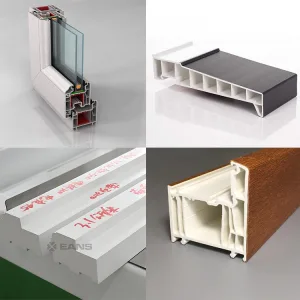
Specify the sections needed for the window system, including their mating parts and reinforcement clearances.
Request output for named profile drawings and formulations. Accepted metres per hour are usually more useful for production planning than an unexplained maximum in kilograms per hour.
The basic relationship is:
Mass output in kg/h = line speed in m/min × 60 × profile weight in kg/m.
For illustration, 180 kg/h corresponds to 2 m/min for a section weighing 1.5 kg/m, or 5 m/min for one weighing 0.6 kg/m. These are assumed values demonstrating the calculation, not machine ratings. The lighter section still needs tooling, cooling, traction, and cutting capable of the higher speed.
Build the daily schedule using running time, quality yield, tooling changes, color changes, and maintenance. Clarify whether a supplier’s output includes rejects. Do not deduct quality losses twice if the quoted rate already represents accepted product.
Ask for a validated operating range rather than a universal percentage of spare capacity. Both your heaviest section and the profile with the most demanding geometry should be reviewed; they may create different limitations.
Conical and parallel twin-screw extruders are both used for rigid PVC profiles. Their suitability depends on the supplier’s processing design, compound, required output, and product range. Screw geometry alone does not establish better quality or lower energy consumption.
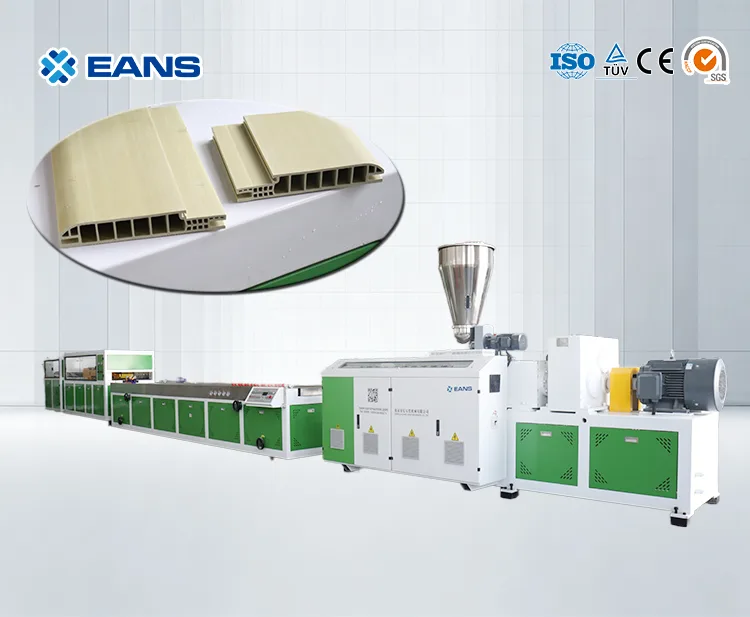
The EANS PVC window profile extrusion machine page describes a conical twin-screw system with profile tooling and downstream equipment. Request its proposed configuration for your actual sections rather than selecting from a headline model or motor rating.
Confirm feeding capacity, screw and barrel design, drive and gearbox suitability, heating and cooling control, venting, sensors, and access for maintenance. The supplier should explain how these items support the intended compound under continuous operation.
Filler characteristics and contamination influence wear. Ask for a material-specific recommendation for screw and barrel protection and the inspection criteria used to monitor wear. Avoid treating one alloy name as a complete explanation of service life.
A PVC heating and cooling mixer prepares the dry blend. Check usable batch mass, full cycle time, material transfer, and storage. An extrusion line can be interrupted by an undersized mixing system even when the extruder has enough capacity.
If you already have a mixer, provide its demonstrated supply rate and the condition of the blend delivered to the line. Confirm compatibility rather than assuming existing upstream equipment will fit the new proposal.
A window-system tooling package may contain several extrusion dies, calibration sets, fixtures, and gauges. List each set by drawing number and revision. State who approves drawings, how trial adjustments are handled, and what documentation is included.
For functional features, identify the mating gasket, glazing bead, reinforcement insert, and any hardware reference. Overall width and height measurements cannot establish that these interfaces fit correctly.
Ask about cleaning access, tooling lifting, changeover steps, wear inspection, and storage. A low machinery price can become a higher project cost if essential tooling and adjustment work remain outside the quoted scope.
Confirm the complete die and calibration package for every profile drawing included in the purchase.

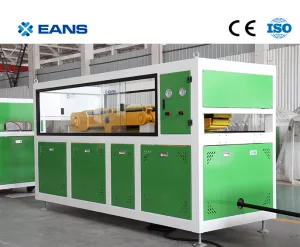
Vacuum calibration supports the hot profile and establishes controlled geometry while cooling removes heat. Review tooling alignment, vacuum control, cooling-water distribution, and access for adjustment.
Cooling length alone is not proof of capacity. The supplier should demonstrate the intended speed with the specified water conditions and inspect profiles after agreed conditioning. Warm profiles can change dimensions after leaving the line.
The haul-off needs stable speed and appropriate gripping pressure for hollow sections. Confirm that the cutter can follow the production speed and handle the required lengths without damaging ends. Stacking and product support should prevent distortion and visible-surface damage.
For the sequence and control points behind these requirements, review the PVC profile manufacturing process guide.
Multiple-strand equipment may suit compatible products with sufficient continuous demand. Review flow balance, independent adjustment where needed, handling, and accepted output for each strand.
Single-strand operation may be simpler when orders are small or the product range changes frequently. Compare complete schedules and changeover losses; the number of outlets alone does not determine saleable capacity.
If the profile requires a different surface layer, an approved recycled core, or an integrated compatible seal, identify every material and layer. Confirm auxiliary extruders, feeding, tooling, controls, and interface testing in the proposal.
Decorative lamination requires a defined preparation and bonding process. Specify film, adhesive, handling, adhesion tests, and compatibility with later welding and corner cleaning. Separate temporary protective film application from decorative lamination in the equipment list.
A demonstration on plain white profiles does not validate every co-extruded or laminated product. Include the required variants in the qualification plan.
Request a general arrangement drawing showing equipment positions, working clearances, maintenance access, material flow, and utility connections. Match it to the actual building, including columns, delivery access, tooling handling, and storage.
Confirm electrical supply requirements, connected load, expected operating demand, cooling-water conditions, compressed-air demand, and extraction arrangements. These details should refer to the proposed configuration.
For energy comparisons, request measured kWh per accepted kilogram or metre at agreed trial conditions. State whether the figure includes mixing, extrusion, vacuum pumps, cooling, air supply, and finishing. Main motor power is not a measured energy-consumption figure.
Compare total cost per accepted metre using material, rejects, utilities, staffing, maintenance, consumables, changeovers, and tooling. Include freight, installation, buyer-supplied auxiliaries, and initial spares in the project budget.

Evaluate the complete equipment arrangement and utility requirements for the proposed production schedule.
| Comparison item | Evidence to request | What an incomplete offer may omit |
|---|---|---|
| Product capability | Named drawings, compounds, colors, and validated configurations | Difficult sections or required material variants |
| Accepted output | Metres and mass per hour under stated quality and utility conditions | Rejects, startup losses, or downstream limitations |
| Tooling scope | Itemized dies, calibration sets, gauges, revisions, and adjustment scope | Extra tooling and qualification charges |
| Energy and utilities | Measured consumption boundary and equipment utility schedule | Cooling, vacuum, compressed air, or finishing consumption |
| Acceptance | Agreed trial materials, running period, sampling, and functional tests | Conditioned dimensions and fabrication checks |
| Support and ownership costs | Installation responsibilities, training, manuals, spares, and written service terms | Site preparation, support exclusions, or component availability |
Use a common quotation revision and record deviations. Ask suppliers to price missing scope separately before ranking offers. A proposal that leaves essential performance conditions unanswered is difficult to compare, regardless of its purchase price.
Use the intended compound and representative tooling during factory testing. Include the commercially important section and a technically demanding section when they test different limits of the equipment.
Repeat the agreed checks during site acceptance. The receiving factory’s water, power, materials, handling, and operators can affect production. Define how open issues will be recorded and resolved before handover.
The EANS PVC window profile production line solution describes equipment spanning material preparation, extrusion, tooling, calibration, cooling, haul-off, cutting, and stacking. Use that scope to request a product-specific proposal.
Ask the technical team to identify the proposed configuration for each section, tooling quantities, expected operating range, factory requirements, options, and acceptance conditions. Keep product performance and commercial commitments tied to the written project proposal.
No. Select a validated operating range that fits the product schedule. Oversizing can increase investment and leave a line poorly utilized; extra extruder capacity also cannot resolve insufficient tooling or cooling capacity.
It can within a confirmed processing and downstream range, using matched tooling. Check the schedule for every section because shared equipment produces the required product mix through separate runs.
No. Equipment documentation and product test evidence serve different purposes. Qualify profiles against their drawings, material requirements, functional interfaces, and applicable product tests.
Send EANS your window profile drawings and production targets, including formulation, output by section, surface or layer requirements, factory utilities, and acceptance criteria. Request an itemized quotation, tooling list, layout, and trial plan so you can compare complete production capability on the same basis.