WPC Door Making Machine Passes Factory Trial for Saudi Arabian Project
22 October, 2026
A factory comparing PVC vs WPC door panels needs to separate the material from the panel structure. A hollow PVC panel and a thick WPC panel differ in geometry, weight, and hardware support as well as composition. Comparing those products without a cross-section drawing can lead to the wrong material choice and an unsuitable production line.
For engineers and procurement managers, the useful comparison is between defined products: the same intended use, finished dimensions, hardware loads, surface finish, and acceptance requirements. This guide focuses on extruded rigid PVC panels and PVC-based wood-plastic composite panels, with particular attention to manufacturing differences.

An extruded PVC door panel has a PVC-based body containing stabilizers, lubricants, processing additives, pigments, and often mineral filler. Here, “PVC panel” means a formulation without intentionally added wood flour or fiber. It does not mean pure PVC resin.
PVC panels can be hollow, foamed, or solid. A PVC door panel machine is selected around the formulation and cross-section. Hollow products require tooling that distributes melt to the skins, internal ribs, and edge sections.

WPC stands for wood-plastic composite. It combines wood flour or fiber with a thermoplastic matrix and additives. WPC can use different polymers, including PVC, PE, or PP; this comparison concerns PVC-based WPC and the related door panel extrusion routes.
Adding wood introduces another raw material with its own moisture, particle-size, and feeding requirements. It can change mechanical and processing behavior, but the result depends on formulation, dispersion, material bonding, and panel construction. A WPC panel can also be hollow or foamed; the name does not guarantee a solid core.
An MDF door covered with PVC film has a wood-based body and a decorative plastic surface. Its manufacturing route uses substrate machining and film application rather than PVC panel extrusion. Check the core material before comparing samples or requesting machinery quotations.

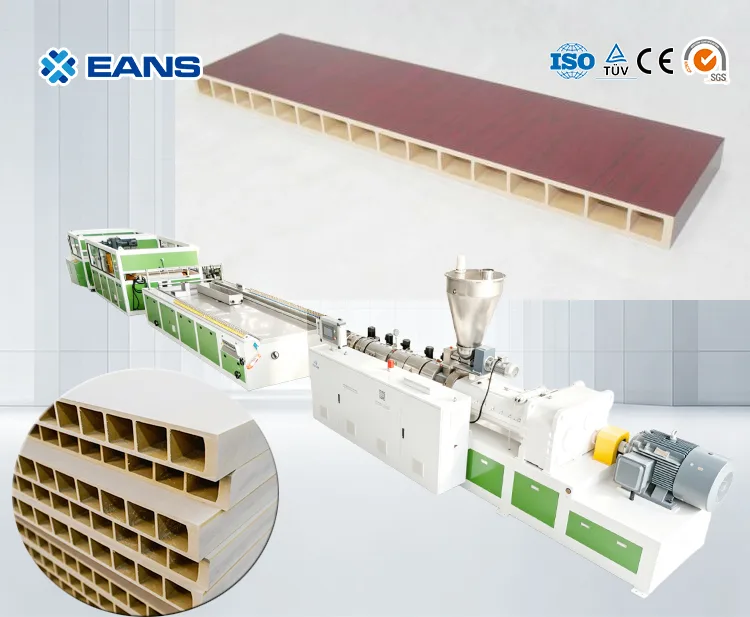
EANS door board and frame examples. Specify the actual compound and cross-section when comparing products.
Both rigid PVC and PVC-based WPC formulations require a controlled balance of resin, stabilizers, lubricants, and processing additives. Mineral filler, impact modifiers, pigments, and foaming agents are selected for the intended product rather than added according to a universal recipe.
For WPC, the specification also needs to describe wood type, particle-size distribution, moisture, cleanliness, and consistency. Wood flour can absorb moisture again after preparation, so handling and storage need to preserve the agreed feed condition.
Wood loading should be expressed on a stated basis. A percentage of the complete compound and parts per hundred resin are different measures. Request a consistent formulation summary before comparing recipes, costs, or trial results.
Start with a wood-free rigid PVC formulation when the product brief does not require a wood-containing composite and it meets the performance target. Add WPC to the evaluation when its tested properties, machining behavior, or commercial positioning justify the extra material-preparation controls.
| Comparison item | PVC panel considerations | PVC-based WPC considerations |
|---|---|---|
| Moisture behavior | No wood fraction; assess the complete compound, joints, finish, and hardware openings. | Wood content and material bonding affect water uptake; check cut edges and conditioned samples. |
| Stiffness and impact | Depend on formula, skin thickness, ribs, density, and reinforcement. | Wood can change stiffness, but greater stiffness does not establish higher impact strength. |
| Hardware attachment | Thin hollow skins may require inserts, backing, or reinforced fixing zones. | Check the actual fixing zone, screw engagement, material quality, and pull-out performance. |
| Weight | Controlled by compound density and cross-section, including cavities or foaming. | Also controlled by density and geometry; WPC is not automatically heavier. |
| Dimensional stability | Check cooling history, temperature exposure, panel support, and installed clearances. | Check thermal movement together with moisture-related changes and processing stresses. |
| Surface appearance | Film, printing, embossing, or another finish can create a woodgrain appearance. | Wood content alone does not guarantee a woodgrain finish; surface processing remains relevant. |
Wood flour is moisture-sensitive. The polymer matrix can limit water access, but WPC water uptake depends on wood content, bonding, processing, and exposure. A claim that WPC is always more waterproof than wood-free PVC is therefore an unreliable basis for selection.
For bathroom or utility-room doors, compare dimensional change, edge behavior, film adhesion, and hardware condition after agreed exposure. Use specimens with the same cut edges and finishing details expected in production.
Stiffness describes resistance to deformation; strength and impact resistance describe different limits. A stiffer compound can still be less tolerant of impact or local defects. Evaluate the complete panel section rather than assigning a general strength ranking to the material names.
For hinges and locks, define the fastening position, screw size, engagement depth, reinforcement, and expected service load. Compare pull-out resistance and repeated operation using the actual assembly. Neither “WPC” nor a heavy panel is proof of reliable screw holding.
Acoustic behavior depends on the door leaf, frame, seals, gaps, and installation. Fire and exterior performance also concern the complete assembly. Specify the relevant test evidence for the intended use instead of inferring a rating from wood content, density, or appearance.
Both routes can follow the same broad sequence: material preparation, feeding, extrusion, die forming, calibration, cooling, haul-off, cutting, finishing, and assembly. WPC changes the material entering those stages and may change the equipment requirements.
Rigid PVC dry blend requires consistent dosing and mixing. A PVC heating and cooling mixer prepares the compound before extrusion.
WPC preparation must also control wood moisture and particle characteristics. The supplier should define whether moisture is removed before extrusion or within a validated processing route. The feeding system must handle the actual blend without bridging or irregular delivery.
Wood preparation can be outsourced by purchasing specified wood flour, or included in the factory scope. Clarify this boundary before allocating space, labor, storage, and utility capacity.

Mixing equipment prepares a consistent compound. A WPC route also needs an agreed method for wood moisture control.
A WPC door production line needs an extrusion unit matched to the composite formulation. Review screw geometry, feeding capacity, drive load, temperature control, venting, and wear protection.
Wood can alter melt flow and mixing behavior. Specify sufficient processing capacity using trials with the intended recipe. Do not assume that every WPC formulation requires the same motor upgrade or that a high-filler PVC line will automatically handle it.
Venting and moisture control should prevent unwanted voids and surface defects. For foamed products, distinguish controlled cell formation from unintended moisture-related bubbles. Operators should evaluate motor current, melt pressure, temperature, and product condition together.
The die and calibrator define the cross-section for both materials. Flow balance must match skins, ribs, edge sections, and any reinforcement pockets. A tooling set validated for one compound may need adjustment or replacement when the formulation changes.
Cooling requirements follow section thickness, material behavior, mass flow, line speed, and water conditions. Do not select a longer cooling table simply because a quotation says WPC. Request a demonstrated cooling arrangement for the proposed panel.
PVC and WPC panels may both require machining, film application, edge treatment, and hardware installation. Review routing quality, dust collection, adhesive compatibility, and surface preparation for each compound.
The EANS PVC/WPC door manufacturing solution provides a starting point for discussing extrusion and downstream processing. Ask for a quotation that identifies which stages are supplied and which remain the buyer’s responsibility.

Door extrusion equipment should be configured around the specified formulation, panel section, and finishing route.
| Production stage | PVC route | Additional WPC evaluation |
|---|---|---|
| Raw materials | Resin, filler, additives, and controlled recycled content | Wood specification, moisture, storage, and preparation scope |
| Feeding and extrusion | Consistent dry-blend delivery and plasticization | Blend flow, dispersion, venting, drive load, and wear suitability |
| Tooling and cooling | Flow balance and dimensional control for the selected section | Validation with the wood-containing compound and intended mass flow |
| Finishing | Machining, film adhesion, edges, and hardware preparation | Composite machining behavior and substrate-specific finish trials |
| Acceptance | Accepted output, dimensions, surface, and assembly checks | The same checks plus defined moisture and composite-quality controls |
Some systems can process rigid PVC and PVC-based WPC, but the supplier must define the supported formulations, tooling, feed arrangements, and changeover procedure. A shared machine model does not establish equal output or quality for both recipes.
Request separate trials for the two intended products. Record accepted output, process stability, motor load, energy use, scrap, and final dimensions. Include cleaning time, tooling changes, formulation changes, and startup losses in the production plan.
WPC based on PE or PP requires a separate compatibility assessment. A line qualified for PVC-based WPC should not be assumed suitable for a different polymer matrix.
Compound price per kilogram is only one input. Compare total panel cost using material consumption, scrap, preparation, utilities, labor, tooling, maintenance, finishing, and required reinforcement.
Measure panel weight rather than calculating a hollow product as a solid slab. Compare accepted panels per hour as well as kilograms per hour: different panel weights can produce different unit outputs at the same mass throughput.
For energy, use measured kWh per accepted panel or kilogram. Define whether drying, mixing, extrusion, cooling, compressed air, and finishing are included. Wood preparation may add energy demand, but a universal PVC-versus-WPC consumption percentage is not a reliable estimate.
For a factory without an established wood-preparation process, a qualified wood-free PVC route simplifies raw-material control. Choose PVC-based WPC when verified product benefits or customer demand justify the additional wood handling and process validation.
No. Wood content can change stiffness and mechanical behavior, but impact resistance, hardware support, and panel strength depend on formulation, density, geometry, processing, and reinforcement. Compare the required properties on representative products.
No. Wood-containing composites can absorb moisture. Check the specific product under the intended exposure, including cut edges and finished surfaces.
No universal price relationship applies. Recipe cost, panel weight, preparation, accepted output, scrap, finishing, and reinforcement determine the manufacturing cost.
Provide panel drawings or samples, material composition, wood specification if applicable, target accepted output, finishing requirements, available utilities, and destination electrical requirements.
Give the machinery supplier a separate specification for each proposed product. Request supported formulations, equipment configuration, tooling scope, utilities, changeover requirements, and a production trial for each route.
To discuss the two configurations, send your PVC and WPC door panel requirements to EANS. Ask for comparable quotations and acceptance conditions so that the material choice can be evaluated against actual production results.